
Clinical Decision Support Software Development
Turn Patient Data Into Actionable Clinical Intelligence
Build AI-powered clinical decision support that helps care teams detect risk earlier, surface relevant patient insights, and make faster, more informed decisions directly within clinical workflows.
Clinical Decision Support Software
Capabilities Built Around Real Care Decisions
Patient Risk Scoring
Score and prioritize patients based on deterioration risk, complications, and changing clinical conditions so high-risk cases surface earlier.
Next-Best-Action Recommendation
Deliver patient-specific recommendations based on current clinical context, care pathways, and available evidence to support faster next-step decisions.
Diagnostic Support
Bring symptoms, medical history, labs, medications, and other patient signals together to support faster, more informed diagnostic assessment.
Evidence-Guided Recommendations
Align decision support with clinical guidelines, protocols, and organizational care standards to improve consistency across teams.
Medication Risk Checks
Flag drug interactions, contraindications, allergies, dosing concerns, and other medication risks within the clinician’s workflow.
Explainable AI Recommendations
Show the clinical signals, evidence, and factors behind AI-generated recommendations so clinicians can review decisions with greater confidence.
Clinical Decision Support
Solutions We Build
Our clinical decision support system development approach focuses on the actual decisions clinicians need to make,
from early risk identification and diagnosis to treatment selection, medication safety, and care-pathway guidance.
-
For Hospitals & Health Systems
-
For Specialty & Complex Care
-
CDSS for Healthcare Quality
& Standardization -
For HealthTech & Digital
Health Products
Clinical Risk & Early Warning Systems
Build clinical risk prediction software that continuously evaluates patient signals to surface deterioration, complications, and high-risk cases before they are missed in busy clinical workflows.
Medication & Treatment Safety Systems
Support safer prescribing and treatment decisions by evaluating medications, patient conditions, contraindications, and therapy-specific risks.
Point-of-Care Decision Support Platforms
Deliver patient-specific recommendations inside the clinical workflow so clinicians can review relevant guidance without switching between disconnected systems.
Specialty-Specific Clinical Decision Support
Build decision logic around the clinical pathways, risk factors, and treatment considerations unique to a specialty instead of forcing teams into generic decision models.
Personalized Treatment Recommendation Systems
Evaluate patient-specific clinical context to support more individualized treatment planning instead of relying only on static protocols.
Diagnostic Decision Support Systems
Bring symptoms, history, labs, observations, and other patient signals together to support clinical reasoning when the diagnosis is unclear or multiple conditions need to be considered.
Evidence & Guideline Intelligence Platforms
Turn clinical guidelines, protocols, and organizational care standards into decision support that can be applied consistently at the point of care.
Care Pathway & Clinical Rules Engine Development
Guide clinicians through condition-specific pathways while helping organizations reduce variation in how common clinical decisions are made.
Embeddable Clinical Decision Engines
Add clinical intelligence to existing healthcare products through reusable decision engines, APIs, and configurable rules rather than rebuilding decision logic for every workflow.
AI Clinical Copilots
Give clinicians a decision-support layer that summarizes patient context, surfaces relevant risks, and brings supporting evidence into the workflow while keeping the clinician in control of the final decision.
Engineer the Right Clinical
AI for High-Stakes Decisions
Choose the right model, clinical data approach, evidence grounding, validation strategy, and workflow integration based on your use case, accuracy needs, care setting, and risk profile.
- Model Selection
- Evidence Grounding
- Data Readiness
- AI Validation
- EHR Integration
- Human Oversight
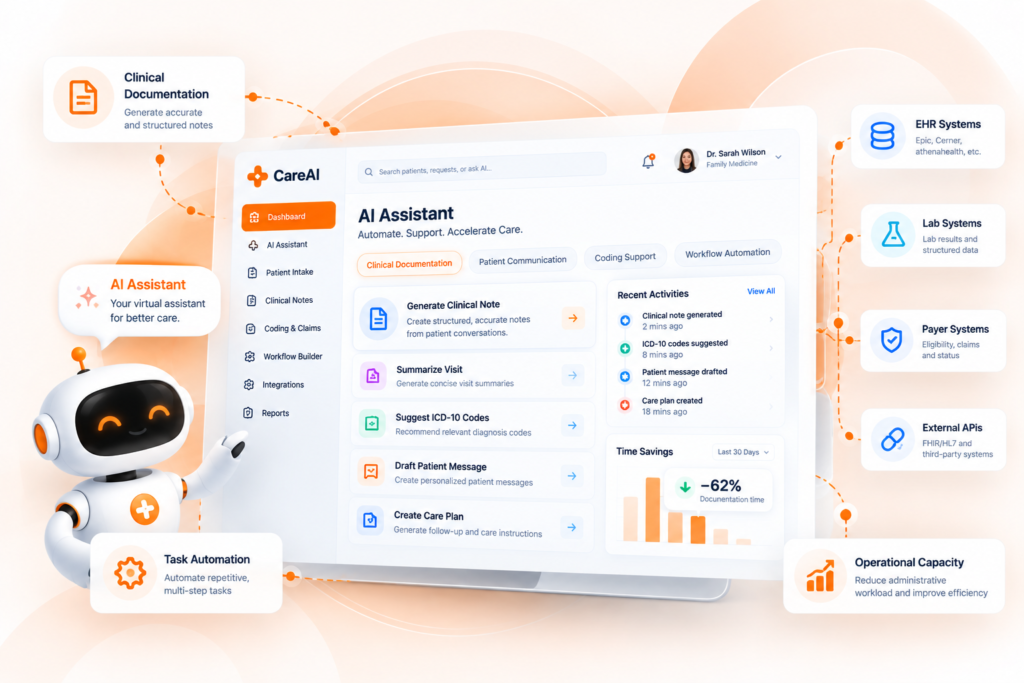
Clinical Systems & Platforms We Integrate With
EHR & Clinical Systems
Oracle Health
athenahealth
eClinicalWorks
NextGen Healthcare
MEDITECH
Greenway Health
Clinical Decision Support Standards
SMART on FHIR
HL7 FHIR
HL7 v2
CQL
REST APIs
Clinical Terminology & Coding
ICD-10-CM
LOINC
RxNorm
CPT
UCUM
Interoperability & Integration Platforms
InterSystems HealthShare
Rhapsody
Redox
Health Gorilla
Clinical Data & Analytics Platforms
Databricks
Microsoft Fabric
Azure Data Lake
Amazon Redshift
AI & Model Platforms
OpenAI
Anthropic
Google Gemini
Amazon Bedrock
Identity & Access Management
Auth0
Microsoft Entra ID
AWS Cognito
OAuth 2.0
SAML
Cloud & Infrastructure
Microsoft Azure
Google Cloud
Kubernetes
Docker
API & Integration Management
AWS API Gateway
Kong
Webhooks
FHIR APIs
How We Approach Clinical Decision
Support Software Development
Define the Clinical Decision
We start with the exact decision the system needs to support—who makes it, what information they need, when support should appear, and what happens after the recommendation.
We define:
- Clinical use cases
- Decision points
- Target users
- Risk thresholds
- Escalation paths
- Success criteria
A clear decision-support scope built around real clinical value, not AI for its own sake.
Build the Clinical Data Foundation
We identify the patient data, evidence, guidelines, and contextual signals needed to produce reliable recommendations.
We structure:
- EHR data
- Labs & vitals
- Medications
- Clinical notes
- Care history
- Guidelines & protocols
Decision logic is grounded in the right patient context and trusted clinical sources.
Design the Decision Intelligence
We determine where AI, rules, scoring models, retrieval, or a hybrid approach makes the most sense for the use case.
We design:
- Risk models
- Recommendation logic
- Evidence grounding
- Clinical rules
- Confidence thresholds
- Explainability
The right intelligence layer for the level of clinical complexity, risk, and oversight required.
Embed Decisions Into Clinical Workflow
We bring recommendations into the systems and moments where clinicians already work instead of creating another standalone application.
We integrate:
- EHR workflows
- Clinical worklists
- Order workflows
- Alerts & notifications
- FHIR & APIs
- Clinician review steps
Decision support appears where it can actually influence care without adding unnecessary workflow friction.
Validate Before Clinical Use
We test recommendations against representative clinical scenarios, edge cases, and failure conditions before they reach production workflows.
We validate:
- Clinical relevance
- Model accuracy
- False positives
- Missed-risk scenarios
- Recommendation consistency
- Explainability
Safer, more dependable decision support with clear boundaries around where AI can and cannot be trusted.
Govern, Measure & Improve
After deployment, we monitor how the system performs in real clinical use and refine it as data, evidence, workflows, and care standards evolve.
We monitor:
- Recommendation quality
- Clinician adoption
- Alert burden
- Model drift
- Override patterns
- Clinical outcomes
A decision-support system that remains useful, governed, and clinically relevant as usage scales.
What Makes Us a Trusted Clinical Decision Support Technology Partner
We combine healthcare engineering depth with hands-on expertise in clinical rule design, EHR integration, decision traceability, and validation workflows. That means your CDS is built to fit real care processes, surface the right guidance at the right moment, and remain easier to govern as it scales.






Know What Your Clinical Decision Support Software Development Will Cost Before You Build
Define the right scope around clinical use cases, AI models, data requirements, EHR integration, validation, and governance so you can plan the investment with clearer cost visibility.
Why Choose HealthApp Systems for
Clinical Decision Support Development
01
Clinical AI Experience
With 18+ years of healthcare technology experience, we understand the clinical, technical, and workflow realities behind AI clinical decision support development not just the AI layer.
02
Lower Build Risk
Start with the right use case, data inputs, validation approach, and integration model so you avoid overbuilding features that clinicians will not use.
03
Workflow Adoption
Design around how clinicians actually work, with EHR integration, explainability, human review, and alert controls built into the experience from the start.
04
Cost Control
Keep investment aligned with the decisions that create the most clinical and operational value, instead of expanding scope around unnecessary AI complexity.
05
Faster Delivery
Move from validated decision logic to production workflows faster with reusable healthcare integration patterns, structured clinical data models, and focused implementation phases.
06
Compliance & Governance
Build with healthcare security, auditability, access controls, validation requirements, model oversight, and governance needs considered across the lifecycle.
Have a Clinical AI Initiative
That Needs to Prove Enterprise Value?
If fragmented data, inconsistent decision support, or low clinician adoption are limiting impact, our custom CDSS development services help shape a practical path from use case to enterprise-ready clinical intelligence.
- Prioritize high-value clinical use cases
- Improve decision consistency
- Strengthen clinician adoption
- Scale with governance and control
Frequently Asked Questions
AI-powered clinical decision support uses patient data, clinical rules, predictive models, and evidence sources to help clinicians make more informed decisions at the point of care. It can support risk detection, diagnosis, treatment planning, medication safety, prioritization, and next-best-action recommendations.
The goal is not to replace clinical judgment, but to give clinicians relevant, patient-specific intelligence when they need it most.
Traditional clinical decision support often relies on fixed rules, static alerts, and predefined pathways. AI-powered systems can analyze larger and more complex datasets, recognize patterns, adapt recommendations to patient context, and support more dynamic decision-making.
A well-designed system may combine rules, machine learning, retrieval, and clinical knowledge rather than relying on AI alone.
AI can support decisions related to patient risk, deterioration, diagnosis, treatment selection, medication safety, triage, care-pathway adherence, and escalation. The right use case depends on the clinical setting, available data, and the level of decision risk involved.
High-value implementations usually start with a clearly defined decision point rather than trying to apply AI across every clinical workflow at once.
Yes. Clinical decision support software can integrate with EHRs through FHIR, HL7, APIs, SMART on FHIR, and other interoperability methods depending on the systems involved.
The most effective implementations bring recommendations into existing clinician workflows rather than forcing users to open a separate application.
Alert fatigue can be reduced by using patient context, risk thresholds, urgency, and clinical relevance to determine when an alert should appear. Not every abnormal signal needs to become an interruption.
AI can also help prioritize alerts, suppress low-value notifications, and route different levels of risk to the right clinical workflow.
Explainable clinical AI should show the patient signals, clinical evidence, rules, or model factors that contributed to a recommendation. Clinicians need enough context to understand why a result was generated before deciding whether to act on it.
Explainability may include evidence references, confidence indicators, contributing factors, and clear visibility into the data used by the system.
Validation should test clinical relevance, model performance, false positives, false negatives, edge cases, data quality, and recommendation consistency across representative patient scenarios.
For higher-risk use cases, validation should also include clinical review, defined performance thresholds, workflow testing, and clear boundaries for when human oversight is required.
Yes. Clinical decision support can be designed around specialty-specific guidelines, workflows, risk factors, treatment pathways, and decision points.
Cardiology, oncology, behavioral health, emergency care, chronic disease management, and other specialties often require different clinical logic rather than a single generic decision model.
The cost of clinical decision support software development depends on the complexity of the clinical use case, AI model requirements, data availability, EHR integration, validation needs, governance controls, and deployment scope.
A focused decision-support use case will usually require a different investment than an enterprise-wide platform supporting multiple specialties and workflows. Defining the clinical objective, data sources, integration path, and validation requirements early helps create a more accurate project estimate.
Clinical AI should be designed as decision support rather than autonomous decision-making unless the use case specifically allows otherwise. Clinicians should be able to review, accept, reject, or override recommendations.
Human oversight, clear escalation rules, audit trails, explainability, and visibility into recommendation confidence are important parts of maintaining clinical control.
Value can be measured through clinical, operational, and adoption metrics depending on the use case. Common measures include time to decision, high-risk case identification, alert acceptance, override rates, guideline adherence, clinician adoption, and workflow efficiency.
The strongest programs define these success measures before development so the system can be evaluated against a clear business and clinical objective.
The required data depends on the use case but may include diagnoses, labs, vitals, medications, allergies, procedures, clinical notes, imaging results, patient history, and longitudinal care data.
The data must also be sufficiently complete, structured, timely, and clinically relevant for the decision being supported. More data does not automatically mean better decision support.