
Healthcare Digital Transformation Consulting
Reduce Healthcare Technology Costs by 30%, Improve Efficiency & Modernize Without Starting Over
Modernize legacy systems, connect fragmented workflows, automate manual processes, and optimize your healthcare technology environment to reduce operating costs, improve efficiency, and extend the value of the systems you already use.
Healthcare Digital
Transformation Capabilities
Digital Strategy & Roadmapping
Assess the current environment and define a healthcare digital transformation strategy with prioritized initiatives aligned with business, clinical, and technology goals.
Application Modernization
Evaluate legacy applications and determine where to optimize, integrate, modernize, replace, consolidate, or retire.
Healthcare Interoperability
Define how clinical and operational data moves reliably across EHRs, applications, platforms, and external systems.
Cloud & Infrastructure Transformation
Modernize healthcare infrastructure around workload requirements, availability, security, and long-term scalability.
Data & AI Transformation
Build the data foundation required for production AI, clinical intelligence, and advanced healthcare applications.
Workflow Transformation
Redesign clinical and administrative workflows by identifying handoff gaps, system friction, and automation opportunities.
What We Transform
Across Your Healthcare Ecosystem
-
Clinical & Care Delivery
-
Operations & Enterprise
Systems -
Data & Interoperability
-
Cloud, AI & Emerging
Technology
Clinical System Modernization
Modernize aging clinical technology through healthcare legacy system modernization while protecting critical workflows, patient data, and interoperability with the systems that remain in place.
Digital Patient Experience
Connect fragmented patient-facing touchpoints across access, communication, virtual care, and self-service.
Healthcare Operations Transformation
Redesign disconnected administrative and operational workflows around integrated systems, shared data, and intelligent automation.
Enterprise Application Modernization
Rationalize complex application portfolios across departments, facilities, and acquired entities to reduce technical debt and duplicated capabilities.
Connected Healthcare Ecosystems
Replace fragmented point-to-point connectivity with scalable interoperability architecture across clinical, operational, payer, laboratory, and third-party systems.
Healthcare Data Modernization
Transform siloed healthcare data into governed, accessible foundations for enterprise applications, reporting, AI, and clinical intelligence.
Cloud Transformation
Modernize healthcare workloads and infrastructure around scalability, availability, security, and long-term operating requirements.
AI-Ready Transformation
Prepare healthcare architecture, data, integrations, governance, and workflows for production AI rather than isolated pilots.
Is Your Healthcare
Architecture Ready for AI?
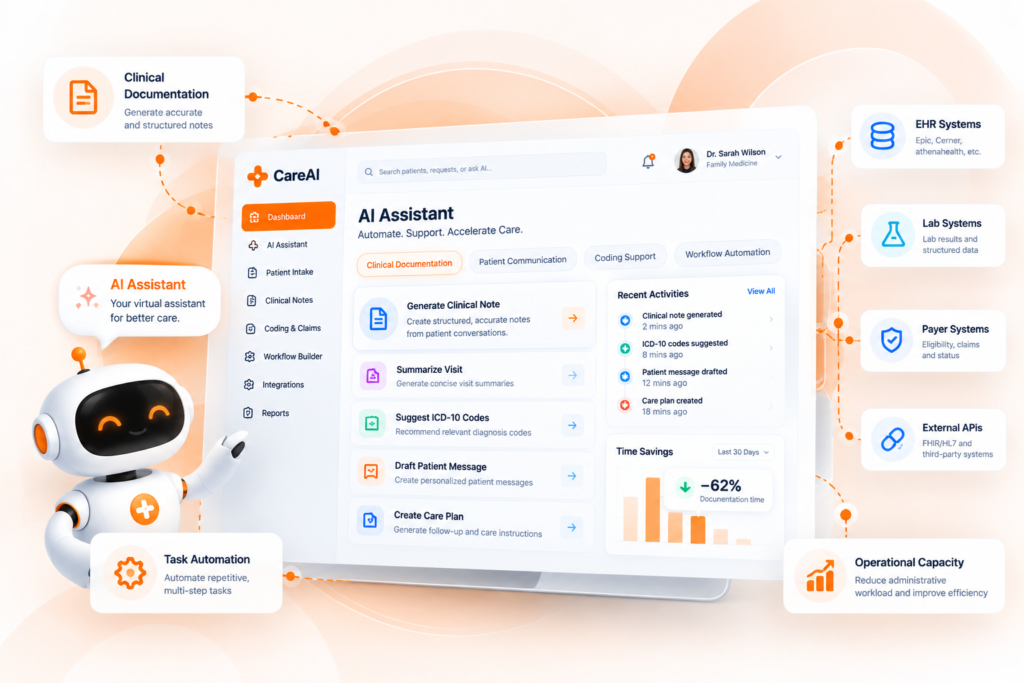
Modernize legacy systems, fragmented data, and integration gaps that slow AI adoption, and build the foundation for AI across clinical and operational workflows.
- AI Readiness
- Data Architecture
- Legacy Modernization
- FHIR & API Integration
- Cloud Infrastructure
How We Approach Healthcare
Digital Transformation
Our healthcare digital transformation services move from current-state assessment and application
rationalization through target architecture, modernization planning, implementation, and measurable transformation.
Assess the Current Environment
Typical timeline: 1–2 weeksWe assess how your applications, infrastructure, data, integrations, and workflows operate today to identify technical debt, operational friction, and modernization priorities.
We assess:
- EHR and application landscape
- Legacy systems and dependencies
- FHIR, HL7, and API connectivity
- Clinical and operational workflows
- Data architecture and accessibility
- Cloud and infrastructure maturity
- Security and compliance gaps
- AI and automation readiness
Outcome: A current-state assessment identifying technology gaps, dependencies, risks, and transformation opportunities.
Define the Transformation Strategy
Typical timeline: 2–4 weeksWe determine what to optimize, integrate, modernize, migrate, replace, consolidate, or retire based on business value and technical health.
This may include:
- Application rationalization
- Healthcare legacy system modernization
- EHR optimization
- Interoperability strategy
- Cloud transformation
- Data modernization
- AI readiness planning
- Workflow redesign
Outcome: A prioritized transformation strategy aligned with business goals, technical dependencies, investment priorities, and implementation risk.
Design the Target Architecture
Typical timeline: 2–4 weeksWe define the target-state architecture required to connect applications, data, infrastructure, interoperability, security, and emerging technologies across the healthcare ecosystem.
We design:
- Target application architecture
- FHIR and API architecture
- Integration and interoperability layers
- Healthcare data architecture
- Cloud infrastructure
- Identity and access controls
- AI-ready data foundations
- Security and governance controls
Outcome: A target-state architecture defining how systems, data, integrations, and infrastructure should evolve.
Build the Transformation Roadmap
Typical timeline: 1–3 weeksWe sequence transformation initiatives around dependencies, operational impact, investment requirements, and implementation complexity.
We define:
- Initiative sequencing
- Modernization phases
- Migration dependencies
- Implementation priorities
- Resource requirements
- Cost considerations
- Risk and change controls
- Success metrics
Outcome: A phased transformation roadmap with clear priorities, dependencies, ownership, and measurable outcomes.
Execute the Modernization
Timeline: Based on transformation scopeWe move prioritized initiatives into implementation while protecting clinical continuity, data integrity, and existing business operations.
Execution may include:
- Application modernization
- Cloud migration
- EHR and system integration
- Data migration
- API enablement
- Workflow redesign
- AI and automation implementation
- Legacy system retirement
Outcome: Modernized technology capabilities deployed through controlled, measurable implementation phases.
Measure & Evolve
OngoingWe measure transformation against defined operational, technology, financial, and adoption metrics and adjust the roadmap as priorities evolve.
We monitor:
- Technology operating costs
- Workflow performance
- System adoption
- Integration reliability
- Application performance
- Cloud utilization
- Transformation ROI
- Emerging technology priorities
Outcome: A continuously evolving digital environment aligned with changing healthcare, operational, and technology requirements.
Stop Investing in Technology That Adds More Complexity
Reduce the cost of maintaining legacy systems, disconnected applications, and duplicated technology by prioritizing modernization investments around measurable business and operational value.
Why Choose HealthApp Systems
01
Healthcare Technology Depth
Modernize with a team backed by 18+ years of healthcare technology experience across clinical systems, interoperability, data, cloud, and digital health transformation.
02
Faster Transformation
Move from assessment to execution up to 30% faster with clear priorities, technical dependencies, and implementation phases defined upfront.
03
Protect Existing Investments
Modernize what limits growth while retaining the applications, infrastructure, and workflows that continue to deliver business and clinical value.
04
Reduce Integration Complexity
Replace fragmented connections with scalable interoperability architecture that improves data exchange across EHRs, applications, payers, labs, and external systems.
05
Build for AI Adoption
Prepare your data, integrations, infrastructure, security, and governance so AI initiatives can move from pilots to production.
06
Control Transformation Risk
Modernize in manageable phases that protect clinical continuity, data integrity, security, and day-to-day operations throughout the transition.
Ready to Modernize
Your Healthcare Technology?
Share what’s limiting your current environment, and we’ll help identify what to modernize, integrate, replace, or optimize to reduce complexity and move your healthcare technology transformation forward.
- Prioritize the right modernization initiatives
- Reduce legacy system and integration complexity
- Prepare your data and architecture for AI
- Build a practical roadmap from strategy to execution
Frequently Asked Questions
Start with the areas creating the greatest operational friction, technology cost, or dependency risk, not with another technology purchase. Map your application portfolio, workflows, interfaces, data flows, and infrastructure to identify where duplicate systems, manual handoffs, technical debt, and integration gaps are limiting performance.
The result should be a prioritized sequence of initiatives rather than a list of technologies to adopt.
Look for problems that cannot be solved through configuration or workflow optimization alone. Persistent data silos, duplicate applications, brittle point-to-point interfaces, unsupported legacy systems, manual workarounds, inaccessible data, and high maintenance costs usually indicate a broader architectural problem.
If the underlying platforms remain viable, targeted optimization may be enough. Healthcare digital transformation consulting should establish that distinction before major replacement or modernization spending begins.
Replacement is only one option. A legacy system can also be retained, reconfigured, API-enabled, modularized, migrated to modern infrastructure, integrated through an interoperability layer, or progressively decomposed.
The decision should consider business criticality, maintainability, security exposure, integration capability, vendor support, data portability, operating cost, and replacement risk. For mission-critical systems, phased modernization often reduces clinical and operational disruption compared with a single large-scale replacement.
Define the target architecture and integration model before adding more applications. New healthcare digital transformation solutions should have a clear place within the EHR ecosystem, identity model, data architecture, API strategy, workflow design, and security framework.
FHIR APIs, HL7 interfaces, integration engines, API gateways, event-driven services, and shared data platforms can reduce point-to-point fragmentation. Technology selection should follow the architecture rather than allowing individual vendor purchases to define it.
AI readiness requires more than selecting an LLM or AI platform. Assess whether the required data is accessible, reliable, sufficiently structured, governed, and available through appropriate interfaces, and whether existing infrastructure can support production workloads.
Also evaluate identity and access controls, PHI handling, model governance, auditability, human review, integration pathways, and monitoring. If critical information remains fragmented across inaccessible legacy systems, those foundations may need attention before AI can scale beyond isolated pilots.
Rank initiatives using both business value and implementation dependency. Consider operating cost, patient or clinician impact, technical risk, regulatory exposure, revenue impact, implementation effort, and whether one initiative enables several others.
For example, improving enterprise interoperability or data architecture may create the foundation for patient access, analytics, automation, and AI initiatives. A transformation roadmap should make these dependencies visible so limited capital is spent in the right sequence.
Design important capabilities so that data and workflows are not unnecessarily locked inside one platform. Use standards-based interfaces such as FHIR and HL7, documented APIs, independent integration layers, portable data models, and clear data ownership requirements where technically feasible.
Vendor dependency cannot always be eliminated, particularly around core EHR functionality. The goal is to identify where strategic flexibility matters and avoid creating new dependencies that make future integration or modernization disproportionately expensive.
Separate transformation into controlled releases rather than changing the entire environment simultaneously. High-risk changes may require parallel operation, phased migrations, interface validation, workflow simulation, user acceptance testing, reconciliation, rollback procedures, and carefully planned cutovers.
Clinical and operational teams should participate before implementation, particularly where technology changes documentation, orders, scheduling, patient access, or handoffs. Clinical continuity should be an architectural and rollout requirement, not just a change-management activity.
Perform application rationalization before automatically renewing, replacing, or consolidating them. Map each application’s business function, users, integrations, data ownership, contract cost, technical health, security exposure, and functional overlap.
Applications can then be classified for retention, optimization, consolidation, modernization, replacement, or retirement. For multi-site health systems, this exercise can also expose duplicate interfaces and local workarounds that would otherwise survive a technology consolidation program.
Build the roadmap around dependencies, funding, operational capacity, architecture, and measurable outcomes, not just strategic priorities. Each initiative should identify prerequisites, affected systems and workflows, ownership, implementation phase, risk, investment requirements, and success measures.
The roadmap should also distinguish foundational work from visible business initiatives.
Data, identity, interoperability, security, or cloud modernization may need to happen before AI, automation, digital front door, or advanced patient-engagement initiatives can scale reliably.
Cost is driven by the scope and depth of the transformation assessment. Key factors include organization size, number of applications and facilities, workflow coverage, integration complexity, legacy-system dependencies, infrastructure, data architecture, and whether the engagement stops at strategy or continues into implementation.
A focused application-modernization assessment will therefore cost substantially less than an enterprise program covering EHR ecosystems, cloud, interoperability, data, AI readiness, cybersecurity, and multi-year transformation planning.
Establish baseline metrics before implementation and measure each initiative against the business problem it was intended to solve. Useful measures can include technology operating cost, application count, interface failures, manual processing time, clinician workflow burden, patient-access performance, system adoption, downtime, and revenue-cycle indicators.
Avoid relying on activity metrics such as the number of systems deployed.
Transformation is creating value when the underlying clinical, operational, financial, or technology metric improves and the improvement can be sustained after implementation.