
Healthcare Interoperability Services
Connect Healthcare Systems with Scalable Interoperability Architecture
At HealthApp Systems, we replace brittle point-to-point interfaces with real-time FHIR R4, HL7 v2, and C-CDA pipelines – connecting Epic, Cerner, payers, and ancillary labs up to 60% faster with full HIPAA and CMS compliance.
Core Capabilities of Our Healthcare
Interoperability Services
EHR & System Integration
Our healthcare integration services connect EHRs, clinical applications, payer platforms, labs, pharmacies, and third-party systems so healthcare data can move reliably across the ecosystem.
Standards-Based Data Exchange
Enable secure healthcare system interoperability using FHIR, HL7, X12, CDA, and other industry standards while preserving the meaning and structure of clinical and administrative data.
Healthcare API Integration
Build and connect healthcare APIs that allow applications, portals, platforms, and partner systems to exchange data without relying on brittle point-to-point interfaces.
Payer–Provider Interoperability
Connect payer and provider systems for claims, encounters, member data, prior authorization, and care coordination workflows.
Healthcare Data Interoperability Services
Transform fragmented healthcare data into consistent formats and terminology so connected systems interpret information correctly.
Interface Modernization
Replace aging interfaces and manual data exchange with scalable healthcare integration solutions that are easier to monitor, maintain, and extend.
Healthcare Interoperability Solutions We Deliver
We connect healthcare systems, data, and workflows across clinical, payer, operational, and third-party environments,
helping organizations reduce integration silos and improve enterprise data exchange.
-
For Clinical Integration
-
For Payers & Health Plans
-
For Digital Health Platforms
-
For Data Exchange
-
For Legacy Modernization
-
For Interoperability Strategy
EHR Integration Services
Connect EHR platforms with clinical, administrative, and external systems to support reliable data exchange across care workflows.
Clinical Data Interoperability Services
Normalize and move clinical data across systems so downstream applications can use consistent, structured information.
Payer Interoperability Services
Support secure exchange across members, providers, claims, prior authorization, and health plan workflows.
Claims & Administrative Integration
Connect payer, billing, eligibility, and administrative systems to improve data movement across financial and operational workflows.
Healthcare API Integration
Connect healthcare applications, portals, SaaS products, and partner platforms through secure, reusable APIs.
Healthcare Software Interoperability
Integrate digital health products with EHRs, patient portals, payer systems, devices, and external healthcare services.
Healthcare Data Exchange
Enable standards-based clinical interoperability across hospitals, health systems, payers, labs, pharmacies, and external partners.
Interface Engine Services
Route, transform, validate, and monitor healthcare messages across complex integration environments.
Interface Modernization
Replace aging point-to-point integrations with scalable, maintainable interoperability architecture.
Integration Architecture
Redesign fragmented integration environments around reusable services, standards, and scalable connectivity patterns.
Healthcare Interoperability Consulting
Assess current integration gaps, standards readiness, and system dependencies before major interoperability initiatives.
Integration Governance
Establish controls for data quality, interface ownership, monitoring, security, and change management across connected systems.
Use AI to Reduce Integration Downtime
Across Healthcare Systems
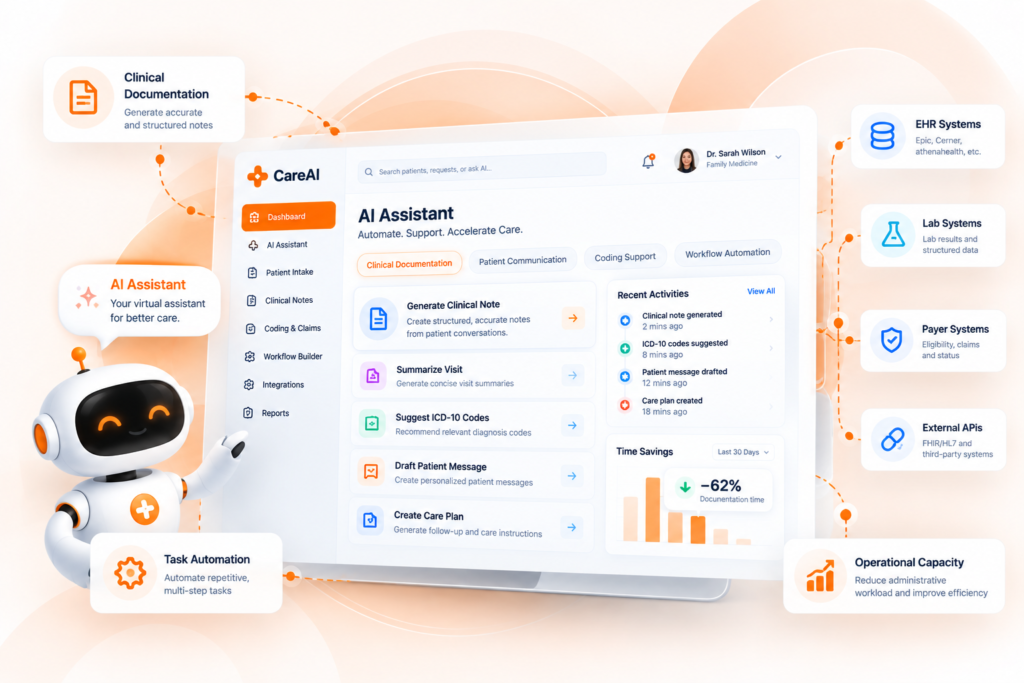
Use AI to detect mapping errors, interface failures, and data-quality issues earlier so IT teams can resolve problems faster and keep critical healthcare data moving reliably.
- Intelligent Data Mapping
- Interface Error Detection
- Data Quality Monitoring
- Message Classification
- Integration Troubleshooting
- Workflow Optimization
Healthcare UI/UX Platforms &
Systems We Design For
EHR & EMR Systems
Healthcare Interoperability Standards
HL7 v2
CDA/C-CDA
X12
SMART on FHIR
USCDI
Payer & Health Plan Systems
Eligibility Systems
Enrollment Systems
Member Portals
Provider Networks
Prior Authorization Platforms
Labs & Diagnostic Systems
RIS
PACS
Diagnostic Labs
Imaging Platforms
Pathology Systems
Pharmacy & Medication Systems
PBMs
ePrescribing Systems
Medication Data Services
Formulary Systems
Patient & Member Platforms
Member Portals
Digital Intake
Care Navigation
Secure Messaging
Self-Service Platforms
Revenue Cycle & Billing
Clearinghouses
Claims Platforms
Billing Systems
Payment Platforms
Denial Management Systems
Healthcare APIs & Middleware
SOAP APIs
API Gateways
Webhooks
Integration Middleware
Service Bus Architecture
Interface Engines
Rhapsody
InterSystems HealthShare
Cloverleaf
Corepoint
Custom Interface Engines
Clinical Terminologies
LOINC
ICD-10
CPT
RxNorm
NDC
Identity & Access Management
Auth0
Microsoft Entra ID
OAuth 2.0
OpenID Connect
SSO
MFA
Healthcare Data Platforms
Databricks
Azure Health Data Services
AWS HealthLake
Google Cloud Healthcare API
Data Warehouses
Digital Health & Medical Devices
IoMT Platforms
Connected Medical Devices
Wearables
SaMD Platforms
CRM & Patient Engagement
Microsoft Dynamics 365
HubSpot
Twilio
Patient Engagement Platforms
Cloud Platforms
Microsoft Azure
Google Cloud
How We Deliver Healthcare Interoperability Implementation Services
Workflow Discovery
We start by understanding how clinicians, patients, members, and operational teams actually use the product.
We define:
- User Roles
- Workflow Gaps
- Task Priorities
- Access Needs
- Device Context
- Success Criteria
A clinical workflow UX direction grounded in how healthcare teams actually work.
Journey Mapping
We map the key paths users take across the product and identify where friction, confusion, or unnecessary steps occur.
We map:
- Clinical Journeys
- Patient Flows
- Member Flows
- Admin Tasks
- Decision Points
- Error States
Clearer user journeys with fewer avoidable interaction gaps.
Wireframing
We structure screens, navigation, information hierarchy, and task flows before visual design begins.
We create:
- Screen Flows
- Page Structure
- Navigation Logic
- Form Patterns
- Data Views
- Interaction States
A practical product structure teams can validate early.
Interface Design
We turn approved workflows into high-fidelity interfaces that balance usability, accessibility, and healthcare data density.
We design:
- UI Components
- Dashboards
- Clinical Views
- Patient Interfaces
- Responsive Layouts
- Design Systems
A consistent interface built for real-world healthcare use.
Usability Validation
We test prototypes against real tasks to uncover friction before development begins.
We validate:
- Task Completion
- Navigation Clarity
- Workflow Accuracy
- Accessibility
- Error Recovery
- User Feedback
Fewer usability issues and less redesign during development.
Developer Handoff
We prepare the design system, interaction logic, states, and specifications engineering teams need to build accurately.
We deliver:
- Design Specs
- Component States
- Interaction Rules
- Responsive Behavior
- Accessibility Notes
- Handoff Documentation
A smoother transition from design to development with less ambiguity and rework.
Why Trust HealthApp Systems as a Healthcare Interoperability Company
We replace fragile, point-to-point HL7 interfaces with resilient, FHIR R4-native integration architectures, connecting Epic, Cerner, payer engines, and ancillary labs in real time with up to 60% faster onboarding and zero data loss.






Plan Your Interoperability Investment Before Integration Complexity Drives Up Cost
Get a focused estimate based on your systems, interfaces, data standards, modernization scope, and testing needs, so you can budget accurately and avoid costly integration rework.
Why Choose HealthApp Systems
01
Native Standards
Our healthcare interoperability experts engineer bi-directional FHIR R4, HL7 v2, C-CDA, and X12 data exchanges with built-in SNOMED CT, LOINC, and ICD-10 terminology normalization.
02
Faster Onboarding
Replace brittle point-to-point interfaces with reusable API connectors, cutting new EHR, lab, and payer integration timelines by up to 60%.
03
Cost Reduction
Eliminate expensive legacy interface engine licensing and manual HL7 troubleshooting, slashing ongoing integration maintenance costs by up to 45%.
04
Enterprise Compliance
Built on HIPAA-compliant, SOC 2 Type II, and TEFCA-aligned architectures with SMART on FHIR OAuth 2.0 security and immutable audit logs.
05
Zero-Drop Reliability
Protect critical clinical and claims feeds with automated schema validation, dead-letter recovery queues, and 99.99% message delivery uptime.
06
Real-Time Visibility
Monitor interface latency, throughput, and payload errors from a centralized observability layer, pinpointing and resolving data bottlenecks before care slows down.
Ready to Fix the Integration Gaps Slowing Down Your Healthcare Ecosystem?
Tell us where disconnected systems, failing interfaces, or inconsistent data exchange are creating operational friction. We’ll help you define custom healthcare interoperability solutions around your current systems, standards, and workflows.
- EHR & Payer Integration
- FHIR, HL7 & X12 Exchange
- Legacy Interface Modernization
- Integration Monitoring & Governance
Frequently Asked Questions
Healthcare interoperability services help healthcare organizations connect EHRs, payer systems, clinical applications, labs, portals, and third-party platforms so data can move reliably between systems.
The goal is to reduce data silos, improve system connectivity, and support consistent information exchange across clinical and operational workflows.
Our healthcare integration services connect EHRs, payer platforms, practice management systems, patient and member portals, labs, pharmacies, revenue cycle platforms, data warehouses, medical devices, and digital health applications.
The integration approach depends on the systems involved, available APIs, data standards, workflow requirements, and existing architecture.
We work with FHIR, HL7, X12, CDA/C-CDA, SMART on FHIR, REST APIs, and other healthcare data exchange standards.
We also support data mapping and normalization when connected systems use different schemas, terminology, or message formats.
Yes. Our healthcare integration solutions connect EHR platforms with external clinical, administrative, payer, portal, and digital health systems without requiring organizations to replace their existing core platforms.
The integration can support real-time APIs, interface engines, messaging workflows, or standards-based exchange depending on the environment.
We assess existing interfaces and identify where reusable APIs, integration layers, interface engines, and standardized exchange patterns can replace brittle one-off connections.
This helps reduce interface sprawl and makes future integrations easier to monitor, maintain, and extend.
Yes. We support payer interoperability initiatives involving Patient Access, Provider Access, Payer-to-Payer exchange, prior authorization, claims, eligibility, and member data workflows.
The architecture can be designed around FHIR-based APIs and the data requirements relevant to the organization’s payer environment.
Yes. Our healthcare interoperability implementation services can assess older interfaces, migrate legacy connectivity, introduce APIs, consolidate integrations, and improve monitoring without requiring a full platform replacement.
The objective is to reduce maintenance overhead while preserving critical workflows during modernization.
Our healthcare data integration services map source and destination data structures, define transformation rules, normalize terminology, validate required fields, and address patient or member matching where needed.
This helps ensure connected systems interpret exchanged data consistently.
We design integrations with controlled authentication, authorization, role-based access, encryption, auditability, and secure data transport.
Security controls are aligned with the type of data being exchanged and the systems involved in each workflow.
We validate message accuracy, field mapping, workflow behavior, error handling, access controls, performance, and exception scenarios before deployment.
Testing also covers how integrations recover from failed messages, unavailable systems, or invalid data.
Yes. We can monitor interface health, message failures, API performance, queue status, data quality, and recurring integration errors.
This gives IT teams better visibility into production issues and helps reduce time spent troubleshooting critical interfaces.
Healthcare interoperability projects typically range from $30,000–$100,000 for a focused integration involving a limited number of systems or interfaces.
Larger enterprise interoperability programs with multiple EHRs, payer systems, API layers, legacy interface modernization, complex data mapping, and ongoing monitoring can range from $100,000–$300,000+ depending on scope and architecture.