
mHealth App Development
Reduce Patient Drop-Off by 3x & Drive Higher Engagement With Custom mHealth Apps
We build custom iOS and Android mHealth apps that connect patients with their care teams, simplify remote monitoring, and improve patient engagement throughout their care journey.
The Capabilities Behind High-Performing mHealth Apps
Mobile Care Access
Design mobile experiences that make it easier for patients to access care, manage appointments, communicate with providers, and stay connected to health services from anywhere.
Connected Health Data
Capture patient-generated data from wearables, connected devices, forms, and in-app tracking, then make that information usable across care and monitoring workflows.
Patient Engagement
Support better adherence with reminders, care plans, medication prompts, progress tracking, and personalized notifications built around ongoing patient activity.
Remote Monitoring
Turn continuous and episodic health data into actionable signals by tracking key metrics, identifying exceptions, and surfacing relevant trends to care teams.
Clinical Integration
Connect the mHealth app with EHRs, EMRs, labs, pharmacies, and other healthcare systems so mobile data becomes part of the broader clinical workflow.
Mobile Reliability
Engineer the app for real-world mobile conditions, including unstable connectivity, background synchronization, device permissions, secure local storage, and consistent performance across devices.
mHealth Solutions We Build
Build mHealth applications around the outcomes that matter most better patient access,
stronger engagement, connected health data, and continuous care outside traditional settings.
-
For Healthcare Organizations
-
For HealthTech & Digital
Health Companies -
For Continuous & Specialty Care
Patient Engagement Apps
Give patients a simpler way to stay involved in their care with mobile tools for appointments, medication routines, communication, education, and follow-up.
Provider-Connected Apps
Reduce gaps between patient activity and clinical workflows by connecting mobile data, communication, and care actions directly with provider systems.
Consumer Health Apps
Turn health tracking and self-management into a mobile experience users can actually adopt, understand, and return to over time.
Connected Health Platforms
Bring mobile apps, wearables, connected devices, backend services, and healthcare integrations together through mHealth platform development that can scale with users and use cases.
Remote Monitoring Apps
Help care teams act on patient data between visits with mobile monitoring, trend visibility, alerts, and patient-reported information.
Specialty mHealth Apps
Build mobile experiences around the specific behaviors, workflows, and monitoring needs of each patient population instead of forcing every care model into the same app.
Improve Patient Engagement and
Care Decisions With AI-Powered mHealth
Apply AI across mHealth experiences to interpret health data, personalize engagement, identify emerging risks, improve adherence, and support faster decisions for patients and care teams.
- Predictive Analytics
- Personalized Engagement
- Risk Detection
- Adherence Intelligence
- Smart Alerts
- Health Data Insights
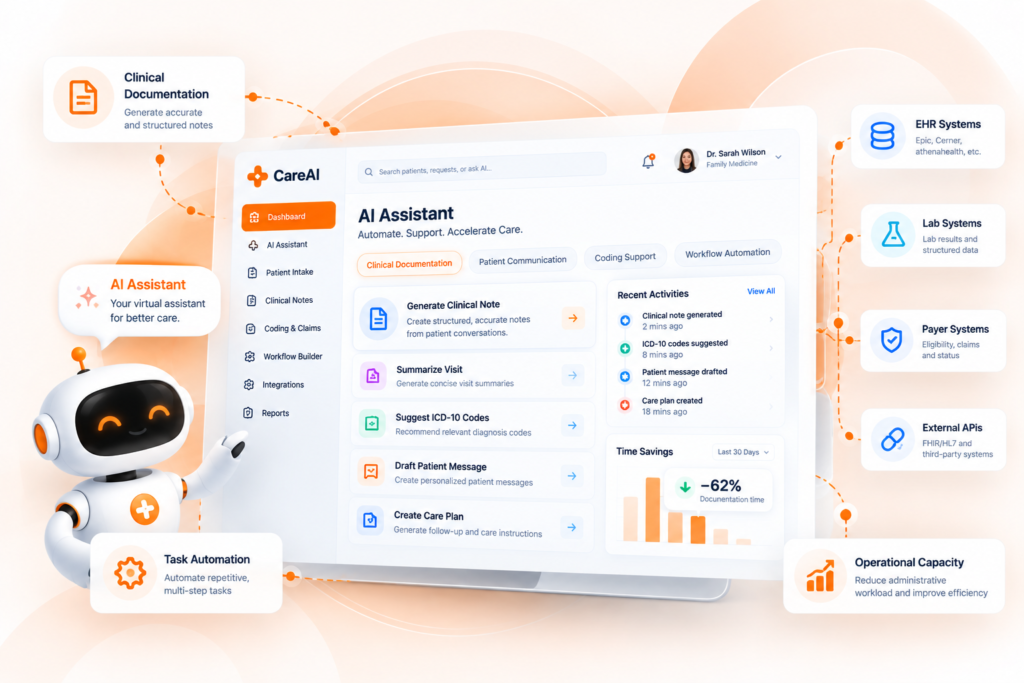
mHealth Platforms & Systems We Integrate With
Connect mHealth applications with the healthcare systems, wearable ecosystems, connected devices,
and digital services involved in continuous mobile care.
EHR & Clinical Systems
Oracle Health
athenahealth
eClinicalWorks
NextGen Healthcare
MEDITECH
Mobile Health Ecosystems
Android Health Connect
Apple Watch
Samsung Health
Wearables & Fitness Devices
Garmin
Withings
Oura
Polar
WHOOP
Connected Medical Devices
Withings
Omron
Abbott
iHealth
Nonin
Remote Patient Monitoring
Validic
Rimidi
Optimize Health
Biofourmis
Current Health
Pharmacy & Medication
DrFirst
DoseSpot
CoverMyMeds
Medisafe
First Databank
Labs & Diagnostics
Labcorp
Redox
Health Gorilla
Particle Health
Zus Health
Healthcare Interoperability
HL7
SMART on FHIR
REST APIs
Webhooks
OAuth 2.0
Identity & Access Management
SendGrid
Firebase Cloud Messaging
Apple Push Notification Service
Amazon SNS
How We Build mHealth Applications
We reduce product risk early, validate the right mobile workflows, and build
mHealth apps that are ready for real-world healthcare use.
Validate the Mobile Care Model
Typical timeline: 1–2 weeksWe start by understanding how the app fits into the actual care journey, who uses it, what data it captures, and where users are most likely to drop off.
We assess:
- Patient and caregiver journeys
- Provider interaction points
- Health tracking requirements
- Wearable and device use cases
- Medication and care plan workflows
- Notifications and engagement triggers
- Existing EHR/EMR dependencies
- Operational and compliance constraints
A validated product direction before development begins, reducing rework and unnecessary feature spend.
Prioritize the Right MVP
Typical timeline: 1–2 weeksWe define what needs to be in the first release, what can wait, and which features are critical to adoption, care delivery, and product validation.
We define:
- Core patient and care team features
- Health data capture
- Device and wearable connectivity
- Engagement workflows
- Notifications and reminders
- Role-based access
- Integration priorities
- MVP and phased releases
A focused build plan that gets the right product to market faster without overbuilding the first release.
Engineer for Mobile Healthcare Conditions
Typical timeline: 1–2 weeksWe design the architecture around the realities of mobile healthcare—intermittent connectivity, sensitive health data, device permissions, background activity, and growing user volumes.
We design:
- Mobile application architecture
- Secure backend services
- Offline and background sync
- Health data models
- Secure local storage
- Wearable and device connectivity
- EHR/EMR integration
- FHIR and HL7 exchange
- Scalable infrastructure
A technical foundation that reduces performance, integration, and scalability issues after launch.
Build in Measurable Releases
Typical timeline: 8–16+ weeksWe develop the app in prioritized releases so critical workflows can be tested early instead of waiting until the entire product is complete.
We build and integrate:
- iOS and Android experiences
- Patient and caregiver workflows
- Health tracking dashboards
- Device and wearable integrations
- Secure messaging
- Notifications and reminders
- EHR/EMR connectivity
- Pharmacy, lab, and third-party APIs
A working product delivered in stages, giving stakeholders visibility into progress and reducing late-stage surprises.
Test for Real-World Use
Typical timeline: 2–4 weeksWe validate the app across the conditions patients actually use it in—not just ideal test environments.
We validate:
- End-to-end user journeys
- Device permissions
- Offline and background behavior
- Data synchronization
- Wearable data flow
- API reliability
- Security and access controls
- Cross-device performance
- Network and battery behavior
- HIPAA-aligned requirements
A release-ready with fewer usability, performance, and data issues reaching production.
Launch & Improve What Matters
OngoingWe support rollout, monitor product behavior, and improve the areas that affect adoption, reliability, and long-term operating cost.
We support:
- App store deployment
- Performance and crash monitoring
- Integration health
- Workflow improvements
- Feature optimization
- New device integrations
- Infrastructure scaling
- Security updates
An mHealth product that keeps improving as usage grows, care programs expand, and product priorities change.
What Makes Us a Trusted mHealth App Development Company
We build mHealth apps around HIPAA safeguards, secure mobile data exchange, consent controls, and HL7/FHIR interoperability. This helps protect PHI, support safer remote access, and maintain reliable patient data flow across mobile and clinical systems.






Reduce mHealth Development Costs Without Limiting Future Scale
Prioritize the right features, integrations, device connectivity, and rollout phases to control mHealth software development costs while keeping the app ready for growing users, care programs, and connected health use cases.
Why Choose HealthApp Systems
01
mHealth Expertise
With 18+ years in healthcare technology, we understand the product, clinical, and technical challenges behind patient-facing mobile health applications.
02
Mobile Reliability
Build for real-world mobile conditions, including weak connectivity, background sync, device permissions, secure storage, and consistent cross-device performance.
03
Connected Data
Bring together patient-generated data, wearables, connected devices, EHRs, and third-party systems without creating fragmented health data flows.
04
Cost Efficiency
Control build and ownership costs through focused MVP planning, practical technology choices, modular development, and phased integration of complex features.
05
Faster Delivery
Accelerate development with reusable healthcare components, proven mobile architecture, established integration patterns, and phased releases focused on high-value features first.
06
Secure Compliance
Design around HIPAA-aligned security, encryption, role-based access, consent, auditability, secure APIs, and protected handling of sensitive health data.
Ready to Build a Better
mHealth Experience?
Share where your current app or product needs to improve, and we’ll help shape the right approach for stronger engagement, connected data, and scalable care delivery.
- Improve patient engagement and adherence
- Connect health data, devices, and care teams
- Strengthen monitoring and follow-up workflows
- Scale across users, programs, and care models
Frequently Asked Questions
A strong mHealth app should support the complete user journey, not just data entry. Depending on the care model, that can include onboarding, health tracking, medication reminders, care plans, secure messaging, appointments, wearable data, alerts, and provider connectivity.
The right feature set should be based on what patients need to do between care interactions.
The cost of mHealth app development is usually shaped by platform choice, user roles, integrations, connected devices, data volume, security requirements, and the complexity of patient workflows.
Apps that include wearables, real-time monitoring, EHR integration, advanced analytics, or multiple care programs typically require more engineering than a standalone patient engagement app.
The decision depends on device access, performance requirements, background processing, sensor usage, and product roadmap.
Cross-platform development can reduce duplicated effort across iOS and Android. Native development may be preferable when the app relies heavily on device-specific capabilities, Bluetooth connectivity, background activity, or deeper operating-system integrations.
The app can receive data through device SDKs, Bluetooth, platform health frameworks, or cloud APIs provided by the device vendor.
Before development, define which measurements are required, how frequently data should sync, whether the information is clinically actionable, and what should happen when device data is delayed, missing, or inconsistent.
Not every data point collected by a mobile app should automatically become part of the clinical record.
Define which information providers need, how it should be summarized, and where it belongs in the workflow. FHIR APIs, HL7 interfaces, and vendor APIs can support exchange, but filtering and clinical context are equally important to avoid creating unnecessary data burden.
Focus on reducing effort and making each interaction useful.
Generic reminders alone rarely create sustained engagement. Personalized goals, relevant prompts, progress visibility, simple data capture, meaningful feedback, and care-team interaction can make the app more useful over time. Engagement should also adapt to the patient’s care journey instead of sending the same experience to every user.
Critical workflows should be designed with intermittent connectivity in mind.
Depending on the use case, the app can securely store selected data locally, queue updates, and synchronize when connectivity returns. Conflict handling, timestamps, retry logic, and clear sync status are important when health information can be updated from multiple devices or systems.
Key controls typically include encryption, secure authentication, role-based access, protected local storage, secure APIs, session management, auditability, and careful handling of device permissions.
Third-party SDKs also need review. Analytics, notification, crash-reporting, wearable, and cloud services can introduce additional data exposure if they are added without considering how health information flows through them.
Start with clinical relevance rather than sending an alert for every threshold change.
Alert logic can combine thresholds, trends, duration, patient context, and repeated readings to identify situations that actually require attention. The workflow should also define who receives the alert, its priority, escalation path, and what happens when nobody acts on it.
Yes. A configurable architecture can share common services while allowing different programs to use their own workflows.
Authentication, messaging, notifications, device connectivity, and data services can remain common, while assessments, goals, thresholds, content, care plans, and engagement rules can be configured for chronic care, rehabilitation, behavioral health, women’s health, or other programs.
Testing should go beyond screens and APIs.
Validate real devices, operating-system versions, permissions, background sync, weak networks, interrupted sessions, wearable connectivity, battery behavior, notifications, security controls, and healthcare integrations. Testing should also cover what happens when data is duplicated, delayed, incomplete, or temporarily unavailable.
A focused MVP can often be developed within a few months, while connected or clinically integrated products require longer.
The biggest timeline drivers are usually device integrations, EHR access, mobile workflow complexity, security validation, data synchronization, QA across device types, and app-store readiness. Defining those dependencies before development helps avoid delays late in the release cycle.