
Medical Device Software Development
Turn Complex Medical Device Workflows Into Reliable, Production-Ready Software
Build SaMD and embedded device software around IEC 62304, validation, and secure EHR connectivity, reducing development risk and improving regulatory readiness.
Core Capabilities For Medical Device
Software Design and Development
SaMD Development
Design and build software as a medical device around clinical use cases, risk controls, and validation requirements.
Embedded Software Development
Develop reliable embedded software for connected medical devices, sensors, and device-side workflows.
IEC 62304 Software Lifecycle
Structure development around IEC 62304 processes to support traceability, documentation, testing, and software lifecycle control.
Device Connectivity & Interoperability
Connect medical devices with EHRs, clinical platforms, cloud systems, and downstream applications through reliable medical device connectivity solutions.
Verification & Validation
Validate software behavior, performance, interfaces, and risk controls before release.
Medical Device Cybersecurity
Build secure software with controlled access, protected data exchange, and device-specific security safeguards.
Medical Device Software Solutions We Build
Our medical device software development services cover device-side applications, SaMD products, connected ecosystems, and clinician-facing systems designed for reliable performance, interoperability, and validation readiness.
-
For Software as a Medical
Device -
For Embedded & Connected
Devices -
For Clinical & Device Data
-
For Clinicians & Patients
-
For Device Operations &
Lifecycle
SaMD Software Development
Build standalone medical software for screening, monitoring, decision support, diagnostics, and therapy workflows.
Digital Therapeutic Software
Develop software-driven therapeutic products that support treatment programs, adherence, and measurable patient progress.
Embedded Medical Device Software Development
Develop software that controls device functions, captures signals, and manages device-side processing.
Medical Device Connectivity Solutions
Connect medical devices with mobile apps, cloud platforms, EHRs, and remote monitoring systems.
Medical Device Data Platforms
Collect, normalize, and manage device-generated data for clinical, operational, and analytical use.
Device-to-EHR Integration Software
Exchange device data with EHRs and clinical systems without disrupting existing workflows.
Clinician Device Management Dashboards
Give care teams visibility into device status, patient readings, alerts, and intervention needs.
Patient Companion Applications
Support medical device application development for mobile and web experiences that help patients connect devices, view progress, and stay engaged with prescribed workflows.
Device Fleet Management Software
Manage connected device populations across provisioning, configuration, monitoring, and maintenance.
Medical Device Software Modernization
Upgrade aging device software, connectivity layers, and interfaces while preserving critical device behavior.
Build AI-Powered Medical Device Software for Smarter Clinical Decisions
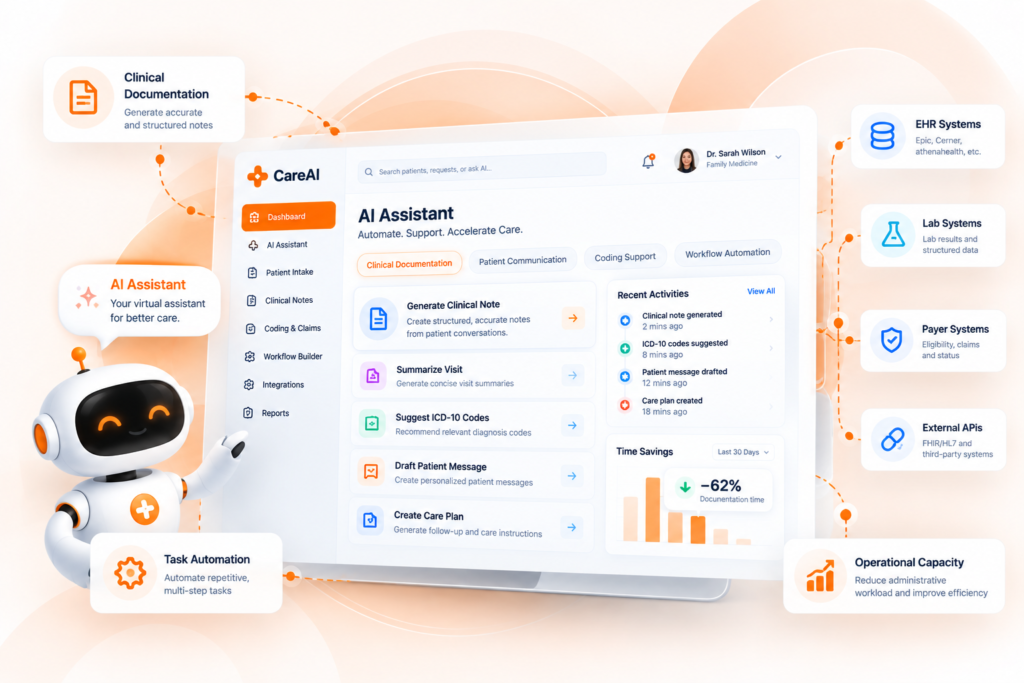
Integrate AI into medical device software to interpret device data, detect meaningful patterns, and support faster clinical decisions without compromising traceability or control.
- Device Data Intelligence
- Signal Pattern Detection
- Predictive Risk Insights
- Clinical Decision Support
- Edge AI Integration
- Model Monitoring
Platforms We Integrate With Medical Device Systems &
EHR & Clinical Systems
Oracle Health
athenahealth
eClinicalWorks
MEDITECH
NextGen Healthcare
Greenway Health
Medical Device Connectivity
Wi-Fi
NFC
USB
Serial Interfaces
MQTT
Device SDKs
Healthcare Interoperability
FHIR
SMART on FHIR
CDA/C-CDA
DICOM
REST APIs
Webhooks
Device Communication Standards
DICOM
USB Device Classes
MQTT
TCP/IP
Secure Device APIs
Remote Monitoring & Connected Health
Apple Health
Health Connect
Withings
Omron
Connected Device APIs
Cloud & IoT Platforms
Azure IoT
Google Cloud
AWS
Microsoft Azure
Device Management Services
Clinical Terminology & Coding
LOINC
ICD-10-CM
RxNorm
UCUM
CPT
Mobile & Companion Applications
Android
Flutter
React Native
Apple HealthKit
Health Connect
BLE SDKs
Identity & Device Access
Auth0
Microsoft Entra ID
OAuth 2.0
OpenID Connect
RBAC
Device Authentication
Data & Analytics Platforms
Databricks
Microsoft Fabric
PostgreSQL
Time-Series Databases
Power BI
Integration & Middleware
InterSystems HealthShare
Rhapsody
Redox
Health Gorilla
MuleSoft
DevOps & Release Engineering
Azure DevOps
GitLab CI/CD
Jenkins
Docker
Kubernetes
How We Approach Medical Device Software Engineering
Requirements Mapping
We translate intended use, device behavior, clinical workflows, and software needs into a clear development scope.
We define:
- Intended Use
- User Needs
- Software Requirements
- Device Interfaces
- Clinical Workflows
- Risk Considerations
A traceable foundation for design, development, and validation.
Architecture Design
We define the software structure for device logic, embedded components, applications, connectivity, and data exchange.
We design:
- Software Architecture
- Embedded Components
- Data Flows
- Device APIs
- Integration Layers
- Security Controls
A reliable architecture built for performance, maintainability, and scale.
Medical Device Software Engineering
We build SaMD, embedded software, companion applications, and clinician-facing interfaces around the approved architecture.
We build:
- SaMD Modules
- Embedded Logic
- Device Applications
- Patient Apps
- Clinician Interfaces
- Backend Services
Production-focused software aligned with real device and clinical workflows.
Device Integration
We connect device-generated data with mobile apps, cloud platforms, EHRs, and downstream healthcare systems.
We integrate:
- Device Connectivity
- HL7/FHIR
- EHR Interfaces
- Cloud Services
- Data Mapping
- API Workflows
Reliable device-to-system data exchange with fewer integration gaps.
Verification & Validation
We test software behavior, interfaces, risk controls, and requirements against defined acceptance criteria.
We validate:
- Functional Requirements
- Software Traceability
- Integration Behavior
- Risk Controls
- Regression Testing
- Performance & Reliability
Stronger verification evidence and fewer issues before release.
Release Readiness
We prepare the software for production deployment, monitoring, updates, and ongoing lifecycle needs.
We support:
- Release Readiness
- Deployment Controls
- Issue Monitoring
- Software Updates
- Change Management
- Lifecycle Maintenance
A safer path from validated software to long-term product operation.
What Makes Us a Trusted Medical Device Software Development Company
We combine custom medical device software development with IEC 62304-aligned lifecycle controls and traceability across design, development, and validation. This helps reduce software risk, strengthen verification, and keep device software better prepared for regulatory review and production use.



Know What Your Medical Device Software Development Will Cost Before You Build
Get a clear estimate based on SaMD vs. embedded scope, device connectivity, IEC 62304 documentation, V&V effort, cybersecurity controls, EHR integration, and deployment architecture—so you can plan the right budget and development path.
Why Choose HealthApp Systems
01
Audit-Ready Code
Built strictly to IEC 62304 and ISO 13485 regulatory standards. We eliminate compliance bottlenecks to pass FDA and CE submissions on the first review.
02
Seamless Interoperability
Native HL7 and FHIR integrations for connected healthcare platforms. Our architecture connects effortlessly with Epic, Cerner, and hospital EHR systems.
03
Workflow Alignment
Designed around real-world clinical use and physician workflows. We engineer intuitive interfaces that doctors trust and hospital IT teams approve instantly.
04
Predictable ROI
Eliminate costly regulatory re-engineering and budget overruns. Clean, modular code slashes long-term maintenance costs by 40% as your product scales.
05
Faster Market
Cut software validation cycles by 50% with automated testing pipelines. Launch compliant SaMD and embedded device software 2X faster without sacrificing safety.
06
Proven Security
End-to-end HIPAA compliance and ISO 14971 cyber-risk management. Protect sensitive patient data with enterprise-grade encryption and zero-trust security.
Ready to Build Your Medical Device Software?
We’ll help you turn device requirements into reliable, validation-ready software with the right architecture, integrations, and development controls.
- Lower Development Risk
- Stronger Validation Readiness
- Reliable Device Integration
- Faster Product Progress
Frequently Asked Questions
Medical device software development is the process of designing, building, testing, and maintaining software that supports, controls, or functions as part of a medical device.
It can include SaMD, embedded software, companion apps, clinician dashboards, device connectivity, and backend platforms that process device-generated data.
Medical device software can include SaMD applications, embedded device software, connected device platforms, patient companion apps, clinician dashboards, remote monitoring systems, medical device data platforms, and device-to-EHR integration solutions.
The right medical device software design depends on intended use, device behavior, risk level, and clinical workflow.
We start by defining intended use, clinical workflows, software requirements, architecture, and risk considerations.
SaMD software development then moves through traceable implementation, verification, integration testing, and controlled release planning so the software is easier to validate and maintain throughout its lifecycle.
HealthApp Systems structures development around software lifecycle activities such as requirements, architecture, implementation, verification, change control, and traceability.
This creates a more controlled engineering process and helps teams maintain clearer technical documentation across development and validation.
Yes. Medical device software can integrate with EHRs using standards and APIs such as HL7, FHIR, REST APIs, and middleware platforms.
These integrations can move device-generated data into clinical workflows while maintaining the right context, mapping, monitoring, and interface controls.
We connect user needs, software requirements, architecture, risk controls, test cases, and validation evidence throughout the development lifecycle.
This helps teams see how each requirement is implemented and verified and makes future changes easier to assess and control.
HealthApp Systems develops the software layers needed to connect devices with mobile apps, cloud platforms, clinician systems, and healthcare data environments.
This can include embedded logic, device APIs, BLE or network connectivity, data synchronization, remote monitoring, and EHR integration.
SaMD performs a medical function without being part of a physical medical device, while embedded medical device software development focuses on software that runs within or directly controls a device.
Both may require rigorous requirements, risk management, testing, cybersecurity, and lifecycle controls depending on intended use and classification.
We validate medical device software against defined requirements, device behavior, clinical workflows, interfaces, risk controls, and performance expectations.
Depending on scope, testing can include functional, integration, regression, reliability, performance, and failure-scenario validation before production release.
Yes. Legacy medical device software can often be improved through targeted refactoring, architecture upgrades, interface modernization, connectivity improvements, and security enhancements.
The modernization path should account for existing device behavior, dependencies, validation impact, and change-control requirements before deciding what to retain or replace.
A focused medical device application may take a few months, while a complex SaMD or embedded device platform can require several phased development and validation cycles.
Timelines depend on intended use, software complexity, hardware dependencies, integrations, risk classification, testing depth, and regulatory documentation requirements.
Medical device software development can range from about 40,000–250,000+ for companion applications, 150,000–500,000+ for embedded device software, and 200,000–800,000+ for SaMD.
Final cost depends on risk level, validation depth, integrations, hardware dependencies, cybersecurity requirements, and regulatory scope.