
Patient Portal Software Development
Build a Patient Portal That Connects Every Step of the Patient Journey
We build secure, connected patient portals that simplify access to care, automate routine patient interactions, and integrate with existing healthcare systems to reduce staff workload and improve the overall patient experience.
Core Capabilities Behind Connected Patient Portal
Patient Portal Architecture
Build scalable portal foundations that support multiple locations, specialties, patient populations, user roles, and evolving digital services.
EHR & Healthcare Integration
Connect portals with EHRs, practice management systems, scheduling, billing, labs, and other healthcare platforms for consistent data exchange.
Identity & Access Management
Protect patient access with secure authentication, identity verification, authorization controls, and account recovery workflows designed around sensitive health information.
Patient Workflow Integration
Connect digital patient interactions with operational workflows so requests, forms, appointments, messages, and other actions reach the right systems and teams.
Clinical & Patient Data Exchange
Give patients controlled access to relevant health information while maintaining accurate synchronization between the portal and connected clinical systems.
Patient Experience Engineering
Design accessible, responsive portal experiences that make it easier for patients to complete common healthcare tasks across web and mobile devices.
Patient Portal Software We Build
Build secure, connected healthcare patient portal solutions around your care model,
patient workflows, existing systems, and digital health strategy.
-
For Healthcare Organizations
-
For HealthTech & Digital Health
Companies -
For Specialty & Continuous Care
Provider Patient Portals
Create a central digital access point for patients to manage appointments, records, communication, forms, billing, and ongoing care interactions.
Multi-Location & Health System Portals
Unify patient access across facilities, departments, specialties, and care teams while connecting with existing enterprise healthcare systems.
Digital Health Patient Portals
Build patient-facing experiences for digital health platforms that connect users with virtual care, health data, care programs, and digital services.
SaaS Patient Portal Platforms
Automate how remittance and payment data is received, matched, posted, reconciled, and connected back to claims and patient accounts.
Specialty Care Patient Portals
Create portal experiences around specialty-specific patient journeys, clinical workflows, follow-ups, and recurring care requirements.
Remote Care & Patient Monitoring Portals
Connect patients with ongoing care outside the facility through remote monitoring, care plans, patient-reported information, and care team communication.
Make Your Patient Portal
More Intelligent, Not More Complicated
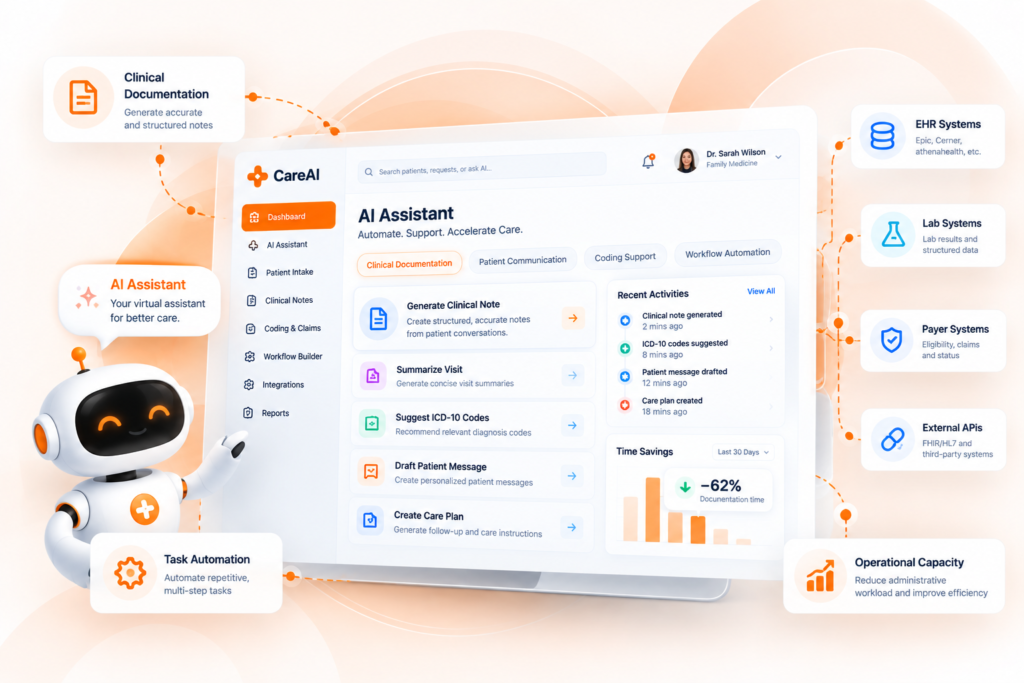
Use AI to help patients find information, navigate care, complete routine tasks, and get relevant support while keeping sensitive workflows connected to the right systems and care teams.
- Conversational AI
- Intelligent Search
- Personalized Guidance
- Document Intelligence
- Workflow Automation
Patient Portal Systems & Platforms We Integrate With
EHR & Clinical Systems
Oracle Health
athenahealth
eClinicalWorks
MEDITECH
NextGen Healthcare
Greenway Health
Interoperability Standards
FHIR
SMART on FHIR
CDA/C-CDA
REST APIs
Webhooks
Patient Identity & Access
Auth0
Microsoft Entra ID
AWS Cognito
OAuth 2.0
OpenID Connect
MFA
Scheduling & Appointment Systems
Google Calendar
Microsoft Outlook Calendar
Calendly APIs
Appointment Reminder APIs
Billing & Payment Platforms
Authorize.Net
Waystar
Availity
Change Healthcare
Experian Health
Patient Communication & Notifications
SendGrid
Firebase Cloud Messaging
Apple Push Notification Service
Secure Messaging APIs
Document & Health Record Exchange
C-CDA
PDF Clinical Documents
Document APIs
Patient Record APIs
ePrescribing & Pharmacy Connectivity
DrFirst
DoseSpot
RxNorm
NCPDP SCRIPT
Remote Monitoring & Connected Health
Apple Health
Health Connect
Withings
Omron
Fitbit
Integration & Middleware Platforms
InterSystems HealthShare
Rhapsody
Redox
Health Gorilla
Cloud & Infrastructure Platforms
Microsoft Azure
Google Cloud
Docker
Kubernetes
Data & Analytics Platforms
Databricks
Microsoft Fabric
Google BigQuery
Amazon Redshift
How We Build Patient Portal Software
We turn patient access needs and healthcare workflows into secure, connected portal experiences that
work across patients, care teams, and existing systems.
Map Patient Portal Workflows
Typical timeline: 1–2 weeksWe assess how patients, caregivers, staff, and clinical systems interact across the complete digital patient journey.
We assess:
- Patient registration & onboarding
- Appointment & scheduling journeys
- Digital intake & consent
- Patient records & results access
- Secure patient-provider communication
- Billing & payment interactions
- Caregiver & proxy access needs
- Existing EHR/PMS and integrations
A clear workflow map showing what patients need to access, what staff must manage, and where existing systems must connect.
Define Portal Modules & Requirements
Typical timeline: 1–2 weeksWe translate patient needs and operational workflows into portal modules, access rules, feature priorities, and a practical development scope.
We define:
- Patient & caregiver account modules
- Appointment management features
- Health records & test results access
- Secure messaging requirements
- Forms, intake & consent flows
- Billing & payment capabilities
- Role and permission requirements
- MVP & release priorities
A prioritized portal scope aligned with patient expectations, clinical operations, and your digital health roadmap.
Design the Portal Architecture
Typical timeline: 2–4 weeksWe design the application, data, integration, identity, and security architecture required to connect the portal reliably with your healthcare ecosystem.
We design:
- Modular portal architecture
- Patient identity & authentication
- EHR/PMS connectivity
- FHIR, HL7 & API integrations
- Clinical data exchange
- Role-based access controls
- Notification architecture
- Audit & security controls
A scalable technical foundation for secure patient access and reliable exchange across connected healthcare systems.
Build & Integrate
Typical timeline: 8–16+ weeksThrough custom patient portal development, we build prioritized portal capabilities and connect them with the clinical, operational, financial, and communication systems behind the patient experience.
We build & connect:
- Registration & digital intake
- Scheduling & appointments
- Records & results access
- Secure messaging
- Forms & consent workflows
- Billing & payments
- EHR/PMS platforms
- Third-party healthcare services
A connected patient portal that brings essential patient interactions into one consistent digital experience.
Validate Patient & System Workflows
Typical timeline: 2–4 weeksWe test the portal across patient journeys, user roles, integrations, devices, accessibility requirements, and real operational scenarios before rollout.
We validate:
- Patient registration & authentication
- Proxy and caregiver access
- Data synchronization
- Scheduling workflows
- Messaging & notifications
- Forms and payment flows
- Responsive & accessibility behavior
- User acceptance testing
A production-ready portal validated for usability, interoperability, security, and real patient workflows.
Launch, Monitor & Improve
Phased / OngoingWe roll out the portal in controlled phases while monitoring adoption, system performance, patient interactions, and opportunities for continued improvement.
We support:
- Data migration
- Phased deployment
- Production monitoring
- Integration troubleshooting
- Patient adoption insights
- Workflow optimization
- Feature expansion
- Performance reporting
A reliable patient portal that can evolve with patient expectations, care models, integrations, and digital health services.
What Makes Us a Trusted Patient Portal Development Company
We build patient portals around real access journeys, role-based access control (RBAC), secure EHR connectivity, and encryption for protected patient data. This helps reduce patient friction while giving care teams a reliable, integrated portal that is easier to operate and scale.







Reduce the Cost of Managing High-Volume Patient Requests
Shift routine scheduling, forms, record requests, billing inquiries, and follow-ups to connected self-service workflows that reduce administrative effort and the cost of manual patient support.
Why Choose HealthApp Systems
01
Healthcare Expertise
With 18+ years in healthcare technology, we understand the clinical, administrative, and patient-facing workflows that a portal must connect across the care journey.
02
Portal Architecture
Build modular patient portals that can expand across specialties, locations, patient populations, user roles, and new digital health services as requirements change.
03
Integration Expertise
Connect patient experiences with EHRs, practice management systems, labs, billing platforms, and other healthcare applications using FHIR, HL7, APIs, and SMART on FHIR.
04
Experience Design
Design intuitive, responsive, and accessible experiences that make common healthcare interactions easier for patients across devices and different levels of digital familiarity.
05
Faster Delivery
Accelerate development by up to 30% using established healthcare engineering patterns, reusable components, and phased delivery of high-priority portal capabilities.06
Built-In Security
Protect patient access and PHI with HIPAA-aligned architecture, role-based permissions, MFA, encryption, audit trails, secure data exchange, and controlled proxy access.
Build a Patient Portal That Works Better for Patients and Your Team
Share what you need to build, modernize, or connect, and we’ll help turn your patient access requirements into a practical development plan.
- Build or modernize patient portal platforms
- Connect EHRs, scheduling, billing, and clinical systems
- Automate routine patient access workflows
- Scale across specialties, locations, and patient populations
Frequently Asked Questions
It depends on the limitations of your current portal. If the underlying platform is stable, targeted modernization may be enough to improve UX, add self-service workflows, introduce APIs, or strengthen EHR connectivity.
A rebuild makes more sense when legacy architecture limits integration, security, scalability, mobile experience, or the ability to introduce new patient services.
Patient portals can connect with EHRs and EMRs through FHIR APIs, HL7 interfaces, SMART on FHIR, vendor APIs, or integration engines depending on the system and workflow.
The integration should maintain consistent patient, appointment, clinical, billing, and communication data while controlling what information patients can access or update.
Yes. For multi-location and health system environments, the portal can use an integration layer to connect with multiple EHRs, practice management systems, and departmental applications.
Patient identity matching, data normalization, access permissions, and synchronization rules become especially important when creating one patient experience across different systems.
Common workflows include registration, appointment scheduling, digital check-in, forms, consent, prescription refill requests, record access, secure messaging, bill payment, and profile updates.
The right workflows depend on which patient requests currently require the most staff involvement and which connected systems can support end-to-end digital processing.
Proxy access should use separate identities and clearly defined permissions rather than shared patient credentials. Access can be configured according to relationship, patient consent, age, organization policies, and the type of health information involved.
The platform should also maintain audit trails showing who accessed information and what actions were performed.
Synchronization can use APIs, FHIR resources, HL7 messages, event-driven integrations, or scheduled data exchange depending on the source system.
The architecture should define which system owns each data element, how updates move between systems, and how duplicates, failed transactions, and conflicting information are handled.
Portal adoption depends on more than interface design. Registration friction, login complexity, limited self-service functionality, disconnected workflows, poor mobile usability, and low-value patient experiences can all reduce usage.
Improvement should start by identifying where patients abandon workflows and which routine interactions can be completed more easily through the portal.
Yes. AI can support conversational assistance, intelligent search, patient navigation, document processing, personalized guidance, and automation of routine requests.
AI should be connected to governed data sources and defined workflows, with appropriate human escalation for clinical, financial, or other high-impact interactions.
Patient portal UX should account for responsive layouts, keyboard navigation, readable content, screen-reader compatibility, clear interaction states, and accessibility standards such as WCAG.
Mobile usability should also be validated across high-frequency workflows such as login, scheduling, forms, messaging, results access, and payments.
Security typically includes identity verification, MFA, role-based permissions, encryption, secure session management, audit logging, API security, and controlled patient and proxy access.
The architecture should also account for HIPAA requirements and protect PHI as it moves between the portal, EHR, third-party applications, and other connected systems.
Timeline depends on portal scope, UX complexity, EHR and third-party integrations, identity requirements, data migration, self-service workflows, and whether the project involves a new build or modernization.
A focused MVP can be delivered faster, while enterprise or multi-system portals are typically better implemented through phased releases.
Cost depends on the number of portal modules, user roles, EHR integrations, patient workflows, identity and security requirements, mobile experience, data migration, and third-party services.
Costs can be managed by prioritizing high-value self-service workflows, reusing existing healthcare systems where practical, and expanding the portal through planned releases.