Generative AI Development Services for Healthcare
Deploy Production-Grade Generative AI Across Your Health System
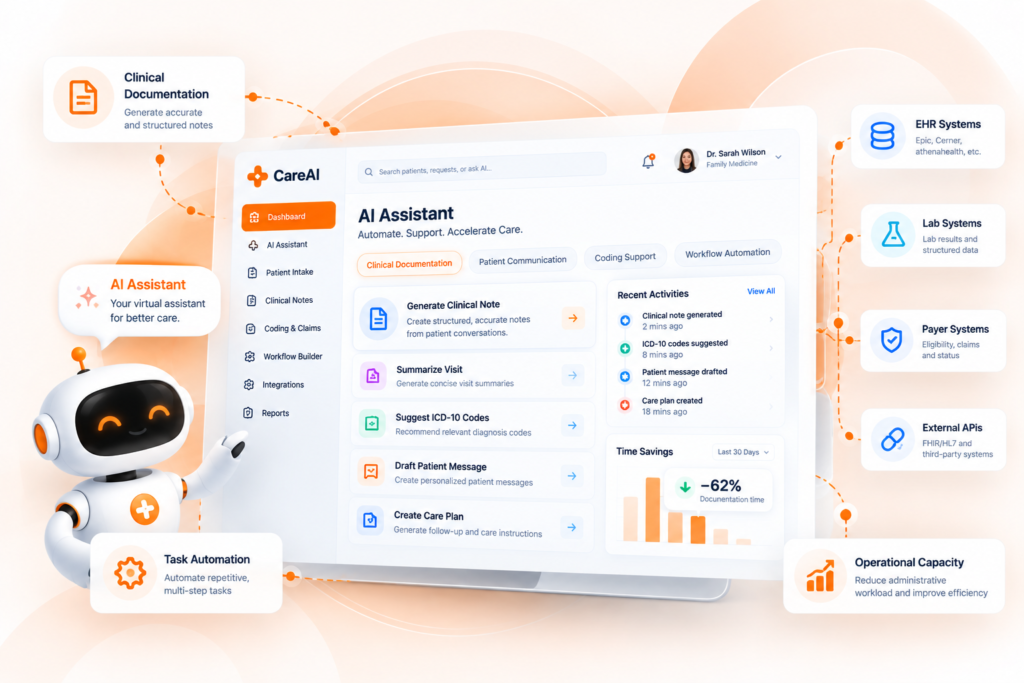
At HealthApp Systems, we build HIPAA-compliant, EHR-integrated GenAI solutions that automate clinical documentation, eliminate physician burnout, and streamline care workflows with verified medical precision.
Core Capabilities for Generative AI
Development in Healthcare
Healthcare RAG Systems
Ground generative AI responses in approved clinical, operational, and enterprise knowledge instead of relying on model memory alone.
Clinical & Staff Copilots
Build AI copilots that help clinicians and healthcare teams retrieve information, summarize records, draft content, and complete repetitive knowledge tasks faster.
Patient-Facing GenAI
Create governed generative AI experiences for patient education, navigation, service questions, and personalized communication.
Medical Document Intelligence
Use generative AI to extract, summarize, classify, and transform information from clinical notes, reports, forms, and healthcare documents.
GenAI Workflow Orchestration
Connect LLMs with EHRs, APIs, internal systems, and business rules so AI can support multi-step healthcare workflows.
GenAI Safety & Governance
Control how models access data, generate responses, use tools, and escalate uncertain or sensitive situations.
Generative AI Healthcare
Solutions We Build
Our healthcare GenAI development services are built around real clinical, administrative, and patient workflows combining healthcare data, approved knowledge, EHR context, and human review to make GenAI useful beyond standalone chat.
-
For Clinical Workflows
-
For Healthcare Knowledge
-
For Patient Experience
-
For Administrative Operations
-
For Healthcare Operations
-
For Enterprise GenAI
Clinical AI Copilots
Help clinicians review patient context, retrieve relevant information, summarize records, and complete knowledge-heavy tasks faster within existing workflows.
Clinical Documentation Assistants
Generate structured drafts and summaries from clinical context while keeping clinicians in control of review and approval.
Healthcare RAG Platforms
Ground generative AI in approved clinical references, policies, internal documents, and authorized healthcare data.
Enterprise Knowledge Assistants
Give healthcare staff conversational access to policies, SOPs, benefits, clinical guidance, and operational knowledge.
Patient Support Assistants
Answer approved patient questions and provide contextual guidance across services, appointments, education, and follow-up workflows.
Patient Communication Generators
Create personalized patient communication using approved content, care context, and communication rules.
Prior Authorization Assistants
Summarize clinical context, retrieve supporting evidence, and prepare information required for authorization workflows.
Revenue Cycle GenAI Assistants
Support RCM teams with denial summaries, payer correspondence, claim context, and document-heavy workflows.
Contact Center Copilots
Support patient service teams with real-time knowledge retrieval, response suggestions, conversation summaries, and next-step guidance.
Healthcare Workflow Copilots
Embed generative AI into repetitive operational workflows that require context gathering, summarization, content creation, or multi-step assistance.
Private Healthcare GenAI Platforms
Create governed healthcare GenAI solutions that connect foundation models with internal healthcare data, applications, and access controls.
Multi-Model GenAI Platforms
Route healthcare workloads across different LLMs based on quality, latency, cost, data sensitivity, and use case requirements.
Scale Generative AI Across the
Healthcare Enterprise
Deploy governed generative AI in healthcare across clinical, administrative, and patient workflows without creating disconnected AI tools. Connect models with enterprise data, EHR systems, and approval controls to improve productivity at scale.
- Enterprise Copilots
- Knowledge Retrieval
- Workflow Automation
- EHR Integration
- Access Controls
- Model Governance
Generative AI Platforms & Healthcare Systems
We Integrate With
EHR & Clinical Systems
Oracle Health
athenahealth
eClinicalWorks
MEDITECH
NextGen Healthcare
Allscripts
Generative AI & Foundation Models
Azure OpenAI
Anthropic Claude
Google Gemini
Amazon Bedrock
Meta Llama
Mistral AI
Healthcare Interoperability
SMART on FHIR
HL7 v2
CDA/C-CDA
REST APIs
Webhooks
RAG & Vector Databases
Weaviate
Milvus
Qdrant
Elasticsearch
Azure AI Search
pgvector
Data & Knowledge Platforms
Clinical Terminologies
LOINC
ICD-10-CM
RxNorm
CPT
UMLS
AI Orchestration Frameworks
LlamaIndex
Semantic Kernel
LangGraph
Custom Agent Frameworks
Document Intelligence
Amazon Textract
Google Document AI
OCR Pipelines
PDF Processing
Clinical Document Parsers
Patient Communication
SendGrid
WhatsApp Business APIs
SMS APIs
Voice APIs
Secure Messaging Platforms
Identity & Access Management
Auth0
Microsoft Entra ID
AWS Cognito
OAuth 2.0
OpenID Connect
RBAC
Workflow & Automation
UiPath
ServiceNow
MuleSoft
Custom Workflow Engines
API Orchestration
Analytics & AI Observability
Tableau
Grafana
Datadog
OpenTelemetry
LangSmith
MLflow
Cloud & AI Infrastructure
Microsoft Azure
Google Cloud
Docker
Kubernetes
Serverless Infrastructure
Security & Secrets Management
AWS Secrets Manager
HashiCorp Vault
Encryption Services
API Gateways
Audit Logging
Model Evaluation & Monitoring
LangSmith
Prompt Evaluation Pipelines
Retrieval Testing
Response Quality Monitoring
Cost Monitoring
How We Build Generative AI Solutions for Healthcare
Use Case Discovery
Our generative AI consulting for healthcare starts by identifying where GenAI can create measurable value across clinical, patient, and administrative workflows.
We define:
- User Needs
- Workflow Gaps
- Data Sources
- Risk Boundaries
- Success Metrics
- Review Points
Outcome: A focused GenAI use case with clear business and workflow value.
Data & Knowledge Preparation
We prepare the clinical, operational, and enterprise knowledge the model needs to produce relevant and grounded responses.
We prepare:
- Clinical Content
- Internal Knowledge
- Structured Data
- Document Sources
- Access Rules
- Data Quality
Outcome: A trusted knowledge foundation for more reliable AI outputs.
Model & RAG Architecture
We select the right model approach and design retrieval, prompting, and orchestration around the use case.
We design:
- Model Selection
- RAG Pipelines
- Prompt Logic
- Vector Search
- Context Management
- Model Routing
Outcome: A healthcare LLM development architecture built for accuracy, performance, and healthcare context.
Workflow & System Integration
We connect GenAI with EHRs, APIs, internal applications, and operational systems so it works inside existing workflows.
We integrate:
- EHR Systems
- Healthcare APIs
- Internal Platforms
- Knowledge Bases
- Workflow Tools
- User Interfaces
Outcome: AI that supports real work instead of becoming another disconnected tool.
Safety & Quality Validation
We test outputs, retrieval quality, permissions, and failure scenarios before the solution moves into production.
We validate:
- Response Accuracy
- Source Grounding
- PHI Access
- Prompt Safety
- Human Review
- Edge Cases
Outcome: More predictable GenAI behavior with stronger control over sensitive healthcare use cases.
Deployment & Continuous Evaluation
We monitor how the solution performs after launch and refine models, prompts, retrieval, and workflows as usage evolves.
We optimize:
- Output Quality
- Retrieval Performance
- Model Costs
- User Feedback
- Workflow Adoption
- Model Behavior
Outcome: A GenAI solution that continues to improve while remaining useful, controlled, and production-ready.
What Makes Us a Trusted Healthcare Generative AI Development Company
Healthcare GenAI is only useful when teams can trust what it sees, what it generates, and who can access it. We design solutions with controlled access to PHI, secure data flows, model-level safeguards, and clear audit trails, so AI can support real healthcare workflows without creating new security gaps.




Know What Your Healthcare GenAI Solution Will Cost Before You Build
Get a practical estimate based on use case complexity, model architecture, RAG, integrations, data controls, evaluation, and deployment scope, so you can plan the right investment before development begins.
Why Choose HealthApp Systems
01
Clinical Accuracy
We engineer healthcare LLMs and RAG architectures fine-tuned on medical ontologies, ensuring zero-hallucination guardrails, verifiable citations, and medical-grade precision.
02
Physician Burnout
Automate ambient clinical documentation and post-visit summary notes, cutting doctor chart time by 3 hours daily and letting care teams focus entirely on direct patient care.
03
Workflow Integration
Deploy generative AI directly inside Epic, Cerner, and existing EHR systems via FHIR standards, helping doctors summarize patient charts and draft notes without leaving their daily interface.
04
Cost Reduction
Automate labor-intensive clinical documentation, prior authorizations, and complex claims processing, slashing operational overhead and administrative costs by up to 45%.
05
Tailored Architecture
Our custom generative AI development for healthcare approach avoids rigid wrapper apps. We architect domain-adapted GenAI models, vector databases, and multi-agent workflows tailored specifically to your health system’s clinical protocols.
06
Zero-Risk Privacy
Built on HIPAA-compliant, SOC 2 Type II enterprise frameworks with strict zero-data-retention agreements, ensuring your proprietary clinical data and PHI are never used to train public AI models.
Ready to Deploy Clinical-Grade Generative AI Across Your Health System?
Tell us what you want to transform across clinical, patient, or operational workflows. At HealthApp Systems, we’ll shape a secure, EHR-integrated GenAI architecture around your clinical data, workflow requirements, and compliance needs.
- Clinical-Grade AI
- Secure Architecture
- EHR Integration
- Workflow Alignment
Frequently Asked Questions
Generative AI development services for healthcare involve building AI solutions that can generate, summarize, retrieve, and transform healthcare information within clinical, patient, and operational workflows.
Typical use cases include clinical copilots, documentation assistants, healthcare RAG systems, patient support, prior authorization, revenue cycle support, and enterprise knowledge assistants.
Traditional healthcare AI is often designed for prediction, classification, or pattern detection. Generative AI focuses more on understanding context and producing new outputs such as summaries, responses, drafts, recommendations, and structured content.
In practice, many healthcare systems use both together depending on the workflow and decision being supported.
Healthcare organizations can use generative AI healthcare solutions for clinical copilots, documentation support, patient communication, knowledge retrieval, prior authorization, revenue cycle workflows, contact center assistance, and internal healthcare knowledge systems.
The right solution depends on where teams are losing time, searching for information, or manually handling repetitive knowledge work.
Healthcare RAG combines a generative AI model with approved healthcare knowledge sources so responses are based on relevant internal or clinical information instead of model memory alone.
This can improve response relevance, source traceability, and control for use cases that depend on policies, clinical references, patient context, or enterprise knowledge.
Yes. Generative AI solutions can connect with EHRs through APIs and standards such as FHIR and HL7 to retrieve the context needed for a specific workflow.
The integration should be designed so the model only receives the data required for the task and does not become an uncontrolled access layer to the EHR.
We control how PHI moves between healthcare systems, AI services, and end users through secure data flows, role-based access, auditability, and clearly defined model permissions.
We also design workflows to limit unnecessary data exposure and keep sensitive outputs reviewable where human oversight is required.
We use techniques such as RAG, approved knowledge sources, prompt controls, source grounding, response evaluation, and human review to reduce unsupported outputs.
For sensitive workflows, the system can also be designed to escalate uncertain responses instead of allowing the model to act independently.
Yes. Generative AI can assist with note drafting, chart summaries, discharge content, referral summaries, and other documentation-heavy workflows.
The AI should support the clinician rather than replace clinical review, with the final output remaining under appropriate human control.
Yes. GenAI can support patient education, service navigation, appointment guidance, multilingual communication, and follow-up interactions.
Patient-facing use cases need tighter controls around approved content, tone, escalation, clinical boundaries, and access to sensitive information.
Custom generative AI development for healthcare makes sense when your data, workflows, security requirements, integrations, or user experience cannot be handled effectively by a standard off-the-shelf implementation.
In most cases, the foundation model itself does not need to be built from scratch. The real value comes from designing retrieval, integrations, permissions, prompts, evaluation, and workflow logic around the healthcare use case.
A focused proof of concept may take several weeks, while production-grade generative AI development for healthcare with RAG, EHR integration, workflow controls, security, evaluation, and monitoring can take several months.
The timeline depends mainly on data readiness, integration complexity, use case risk, model architecture, and validation requirements.
The cost varies significantly based on the use case, model choice, RAG architecture, integrations, data preparation, security controls, evaluation, and expected usage volume.
A focused healthcare GenAI implementation may start in the tens of thousands of dollars, while larger multi-workflow or enterprise deployments can require substantially higher investment depending on scope and infrastructure.