Remote Patient Monitoring Software Development
Detect Patient Deterioration Earlier & Reduce Avoidable Escalations With Custom RPM Software
Build remote patient monitoring software that helps care teams catch deteriorating trends sooner, reduce unnecessary escalations, and manage more patients through connected device data, prioritized alerts, and coordinated follow-up.
The Capabilities Behind
Smarter Remote Patient Monitoring
Device Data Ingestion
Capture readings from blood pressure monitors, glucometers, pulse oximeters, weight scales, wearables, and other connected devices without forcing care teams to manage separate data sources.
Exception-Based Monitoring
Reduce unnecessary review by surfacing abnormal readings, worsening trends, missed measurements, and meaningful deviations instead of making staff manually inspect every data point.
Escalation Workflows
Route high-risk events to the right care team based on severity, condition, patient profile, and predefined escalation rules.
Patient Adherence Tracking
Identify patients who stop taking readings, lose device connectivity, or fall outside their monitoring routine before they disappear from the program.
RPM Documentation
Capture monitoring activity, interventions, communication, and care-team actions in a structured workflow that supports clinical visibility and program accountability.
EHR Workflow Integration
Push relevant RPM insights into existing clinical workflows so providers can act without relying on a disconnected monitoring dashboard.
RPM Solutions We Build
Our custom remote patient monitoring software development approach is built around how monitoring programs actually operate,
from patient enrollment and device activation to exception review, escalation, documentation, and follow-up.
-
For Provider-Led RPM Programs
-
For Device-Driven RPM Programs
-
For Exception-Based Monitoring
-
For Scalable RPM Operations
Chronic Condition Monitoring
Build condition-specific RPM programs that track meaningful physiological changes, adherence, and care-team interventions over time.
Post-Discharge RPM
Monitor patients after discharge to catch deterioration earlier, support recovery, and reduce gaps between inpatient care and follow-up.
Connected Device Monitoring
Build RPM platforms that ingest, normalize, and route data from home-based medical devices and wearables into care-team workflows.
Device Enrollment & Provisioning
Support the operational side of RPM with workflows for patient-device assignment, activation, connectivity checks, replacement, and ongoing device status.
Risk & Escalation Platforms
Help care teams work from prioritized exceptions instead of reviewing every reading manually.
Monitoring Workspaces
Create operational dashboards for reviewing patient status, missed readings, interventions, open tasks, and unresolved risk events.
Multi-Program RPM Platforms
Support multiple conditions, care models, device types, and provider teams through remote patient monitoring platform development designed for one configurable RPM environment.
EHR-Connected RPM Systems
Connect meaningful RPM data and care-team actions back into the clinical record instead of leaving them inside standalone remote health monitoring software.
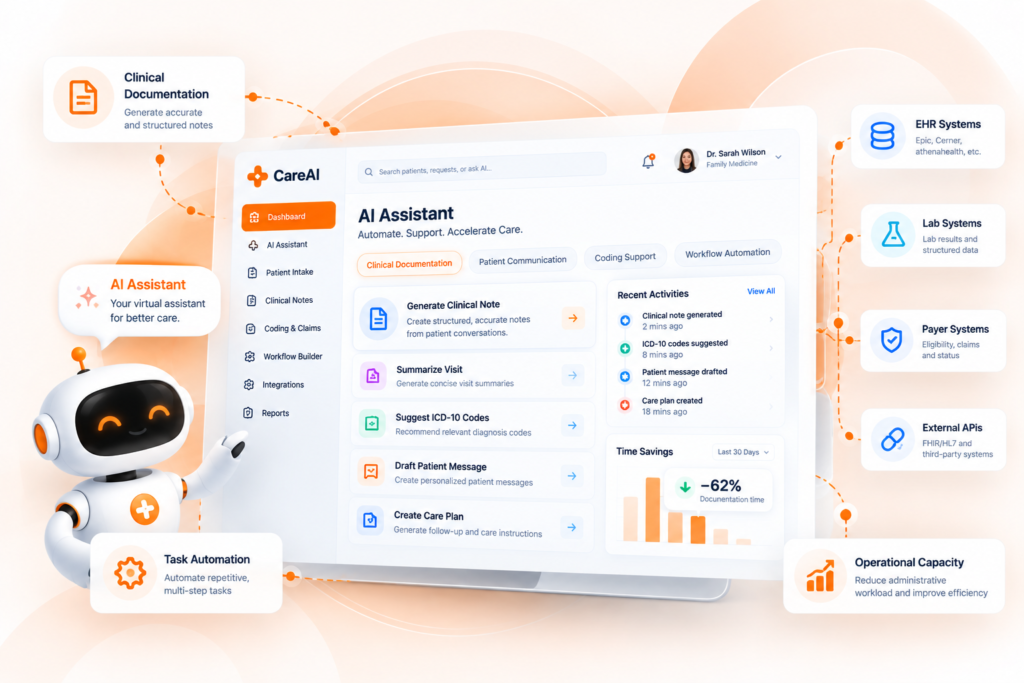
Make RPM More Predictive,
Focused, and Actionable With AI
Use AI to identify emerging risk earlier, reduce alert overload, improve patient prioritization, and help care teams act faster across growing RPM populations.
- Predictive Risk Scoring
- Trend Detection
- Alert Prioritization
- Adherence Intelligence
- Clinical Decision Support
- Human-in-the-Loop
RPM Systems & Platforms We Integrate With
Cardiac Monitoring Devices
Holter Monitors
Blood Pressure Monitors
Pulse Oximeters
Connected Scales
Diabetes Monitoring Devices
Blood Glucose Meters
Smart Insulin Pens
Connected Insulin Pumps
Respiratory Monitoring Devices
Pulse Oximeters
Connected Inhalers
Respiratory Rate Sensors
Chronic Care & Vital Monitoring
Weight Scales
Activity Trackers
Sleep Monitors
Multi-Parameter Vital Signs Devices
Wearables & Biosensors
Fitness Trackers
Wearable ECG Sensors
Skin Patches
Continuous Biosensors
Remote Monitoring Platforms
Current Health
BioIntelliSense
Huma
CareSimple
EHR & Clinical Systems
Oracle Health
athenahealth
eClinicalWorks
NextGen Healthcare
MEDITECH
Healthcare Interoperability Standards
FHIR
SMART on FHIR
IEEE 11073
REST APIs
Webhooks
Device Connectivity
Wi-Fi
MQTT
NFC
Cellular Connectivity
WebSockets
Integration & Middleware Platforms
InterSystems HealthShare
Rhapsody
Redox
Health Gorilla
Cloud & IoT Infrastructure
Azure IoT Hub
AWS
Microsoft Azure
Google Cloud
Identity & Access Management
Auth0
Microsoft Entra ID
AWS Cognito
OAuth 2.0
SAML
How We Build RPM Software
We design around the operational realities of RPM from patient enrollment and
device setup to daily monitoring, escalation, intervention, and program growth.
Structure the RPM Program
Typical timeline: 1–2 weeksWe define how the RPM program will run operationally before translating it into software.
We map:
- Patient eligibility and enrollment
- Condition-specific monitoring plans
- Device assignment and activation
- Measurement schedules
- Care team roles and coverage
- Monitoring hours
- Escalation ownership
- Follow-up and intervention paths
A clear operating model showing who does what, when data is reviewed, and how patient issues move through the program.
Configure Monitoring Rules
Typical timeline: 1–2 weeksWe define how readings should be evaluated so care teams are not forced to manually review every incoming data point.
We configure:
- Patient-specific thresholds
- Condition-based ranges
- Trend and deviation rules
- Missed-reading logic
- Repeat-reading requirements
- Risk levels
- Alert severity
- Escalation triggers
Outcome: A monitoring framework that turns raw device readings into prioritized, actionable work.
Connect Devices & Data
Typical timeline: 1–2 weeksWe design how patients, devices, readings, and clinical systems stay correctly linked throughout the monitoring lifecycle.
We establish:
- Patient-device pairing
- Device activation flows
- API and Bluetooth connectivity
- Reading ingestion
- Data normalization
- Device health and connectivity status
- EHR/EMR data exchange
- Failed-sync and retry handling
A reliable device-to-clinical data flow with fewer gaps, mismatches, and manual corrections.
Build Daily Monitoring Operations
Typical timeline: 8–16+ weeksWe build the care-team workflows used to review patients, resolve exceptions, document action, and manage follow-up every day.
We build:
- Monitoring work queues
- Risk-prioritized patient lists
- Missed-reading queues
- Alert review workflows
- Care team task assignment
- Escalation and handoffs
- Patient outreach workflows
- Intervention documentation
- EHR write-back
A working RPM operations layer that helps teams move from patient signal to documented action without relying on spreadsheets or manual tracking.
Validate Failure & Escalation Scenarios
Typical timeline: 2–4 weeksWe test the conditions that create operational risk in live RPM programs, not just normal device readings.
We validate:
- Device disconnects
- Missing readings
- Duplicate readings
- Incorrect patient-device mapping
- Delayed data
- False or repeated alerts
- Unanswered escalations
- Shift and team handoffs
- EHR sync failures
- High-volume monitoring periods
A release-ready RPM system that handles exceptions predictably before they become staff or patient safety issues.
Optimize Program Performance
OngoingWe refine the platform based on how the RPM program performs after launch.
We optimize:
- Alert volume
- Patient adherence
- Device connectivity
- Queue workload
- Escalation response
- Care team capacity
- Monitoring rules
- Additional condition programs
- New device integrations
- Infrastructure capacity
An RPM program that can support more patients and conditions without increasing operational complexity at the same rate.
What Makes Us a Trusted Remote Patient Monitoring Software Development Company
We build RPM platforms around HIPAA safeguards, HL7/FHIR interoperability, secure device connectivity, and reliable clinical data exchange. This helps care teams monitor patients consistently, protect sensitive health data, and act on remote patient insights with greater confidence.


Lower RPM Operating Costs While Managing More Patients
Reduce day-to-day RPM overhead by simplifying device management, cutting unnecessary alert review, and minimizing manual follow-up while controlling long-term RPM software development and operating costs.
Why Choose HealthApp Systems
01
RPM Experience
With 18+ years in healthcare technology, we understand the clinical and operational realities behind device enrollment, patient monitoring, alert handling, escalation, documentation, and ongoing RPM program management.
02
Operational Efficiency
Reduce manual monitoring work with prioritized patient queues, exception-based review, automated task routing, and structured escalation workflows that help care teams focus on patients who need attention first.
03
Integration Depth
Connect device readings, monitoring activity, interventions, and patient status with EHRs, care management systems, and third-party platforms using FHIR, HL7, APIs, and device integrations.
04
Cost Control
Lower RPM operating costs by reducing unnecessary alert review, manual device coordination, duplicate documentation, and repetitive follow-up as patient volumes increase.
05
Faster Delivery
Accelerate RPM implementation by up to 30% using reusable healthcare components, established monitoring workflows, device integration patterns, and phased releases focused on high-priority program requirements.
06
Secure Compliance
Build RPM workflows around HIPAA-aligned security, encrypted data exchange, role-based access, audit trails, consent controls, and secure handling of patient-generated health data.
Have an RPM Program
That Needs a Better Operating Model?
Share where RPM operations are creating friction, and we’ll help define the right workflow and technical approach.
- Improve device onboarding and connectivity
- Prioritize meaningful patient exceptions
- Strengthen escalation and follow-up
- Keep RPM data connected to the EHR
Frequently Asked Questions
A useful RPM platform should support the full monitoring operation, not just data capture. That usually includes patient enrollment, device assignment, reading ingestion, threshold and trend logic, exception queues, adherence tracking, escalation, intervention documentation, and EHR connectivity.
The platform should help care teams move from incoming data to action without creating extra manual work.
The cost of remote patient monitoring software development is mainly driven by device integrations, number of monitored conditions, alert logic, patient and care-team workflows, EHR integration, reporting, mobile requirements, and expected monitoring volume.
A single-condition RPM product with a small device set is much simpler than a multi-condition platform supporting multiple device vendors, configurable thresholds, escalation workflows, and enterprise integrations.
Alerts should be based on clinical relevance, not every value outside a static range.
Good RPM logic can consider patient-specific thresholds, repeated abnormal readings, rate of change, trends over time, missed measurements, and condition-specific rules. The goal is to surface meaningful exceptions while avoiding alert fatigue for care teams.
The platform should distinguish between a patient who missed a scheduled reading, a disconnected device, delayed transmission, and a true data failure.
That usually requires device status monitoring, timestamps, retry logic, adherence rules, missed-reading queues, and clear follow-up workflows. Otherwise, care teams can waste time treating technical gaps as clinical exceptions.
Yes. Device integration should be designed around a normalized data model rather than treating every device as a separate workflow.
Different vendors may use APIs, Bluetooth, cloud connectors, or proprietary SDKs. The RPM platform should standardize measurements, units, timestamps, device identity, and patient mapping before data reaches monitoring workflows.
Only clinically useful RPM information should be pushed into the EHR.
Raw device streams can overwhelm the clinical record. A better approach is to send relevant readings, summarized trends, interventions, monitoring notes, and escalation outcomes using FHIR, HL7, or vendor-specific APIs while keeping detailed monitoring activity inside the RPM platform.
Start by moving from simple threshold alerts to exception-based monitoring.
Combine repeated readings, trends, duration, patient context, adherence, and severity before generating work for the care team. Alerts should also have clear ownership, priority, escalation paths, and closure rules so unresolved events don’t get buried in a dashboard.
The software should reflect how monitoring teams actually work each day.
That can include prioritized patient queues, task assignment, escalation ownership, outreach documentation, intervention tracking, shift handoffs, unresolved-event follow-up, and EHR write-back. Clear operational workflows become increasingly important as patient volume grows.
Adherence usually depends on removing friction around device use and follow-up.
The platform should track missed readings, device connectivity, activation status, and repeated gaps in monitoring. Timely reminders, simple device setup, clear patient instructions, and structured outreach workflows help teams intervene before patients disengage from the program.
Yes. A configurable RPM architecture can support different conditions without creating a separate system for each program.
Thresholds, measurement schedules, devices, escalation rules, care-team roles, and follow-up workflows can be configured independently for hypertension, diabetes, CHF, COPD, post-discharge monitoring, and other programs while sharing the same core platform.
Testing should cover real monitoring failures, not only normal device data.
Validate disconnected devices, duplicate readings, delayed data, incorrect patient-device mapping, missed readings, repeated alerts, escalation failures, care-team handoffs, EHR synchronization, access controls, and high-volume monitoring scenarios. These are the issues most likely to create operational problems after launch.
A focused RPM MVP can often be delivered in a few months, while multi-device, multi-condition, or enterprise-integrated platforms require longer.
The main timeline drivers are device vendor access, integration complexity, monitoring-rule definition, EHR connectivity, care-team workflow validation, security testing, and pilot feedback. Defining these dependencies early prevents avoidable delays later.