
Healthcare AI Development
Build Healthcare AI Around Your Workflows 2X Faster & Cut Manual Work by 40%
We design and build custom healthcare AI solutions around your clinical and operational workflows, from intelligent automation and predictive models to generative AI and AI agents, integrated with your EHR, data, and existing healthcare systems.
Healthcare Managed
It Capabilities
IT Infrastructure Management
Keep critical healthcare infrastructure available, stable, and performant through proactive IT infrastructure management across on-premises, cloud, and hybrid environments.
Cloud Operations
Manage healthcare workloads across AWS, Azure, and hybrid environments while controlling performance, availability, capacity, and cloud resource utilization.
Application Management
Maintain the availability and performance of EHRs, clinical applications, patient-facing systems, and integrated healthcare platforms.
IT Service Desk
Resolve user and system issues through structured support tiers while reducing recurring incidents and escalation pressure on internal IT teams.
Managed Security
Protect healthcare systems, endpoints, networks, and PHI through continuous security operations, vulnerability management, and access controls.
Business Continuity & Recovery
Protect critical healthcare operations with resilient backup, recovery, and continuity processes designed to reduce downtime when systems fail.
Healthcare Systems
We Manage & Support
-
Clinical Systems
-
Infrastructure & Cloud
-
Business & Patient-Facing
Systems
EHR & Clinical Applications
Keep core clinical applications stable, available, and supported across daily healthcare operations.
Healthcare Integration Systems
Maintain the integration infrastructure connecting clinical applications, external systems, and healthcare data sources.
Healthcare IT Infrastructure
Manage the infrastructure supporting clinical and business operations across on-premises, virtualized, and hybrid environments.
Cloud Environments
Operate healthcare workloads across cloud platforms with continuous attention to availability, capacity, performance, and cost.
Healthcare Business Applications
Support the operational applications healthcare teams depend on across administration, revenue, communication, and internal workflows.
Digital Health Platforms
Keep patient-facing and connected healthcare platforms reliable as usage, integrations, and operational requirements grow.
Can Your Healthcare
IT Environment Support AI at Scale?
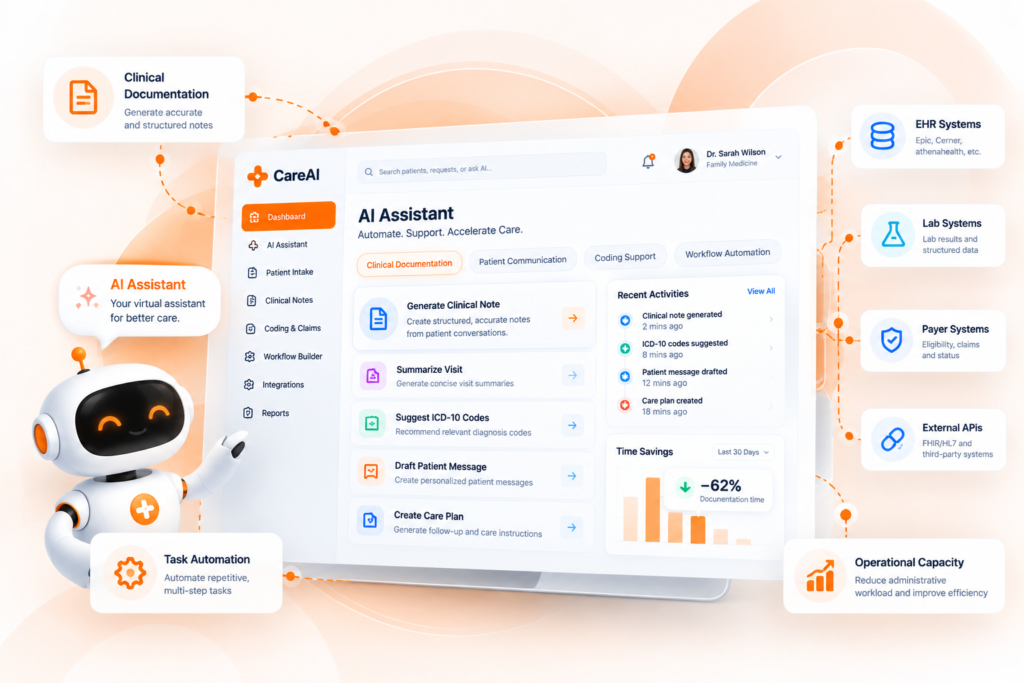
Prepare your infrastructure, cloud, security, and operations for AI workloads while maintaining the availability, performance, and control your critical healthcare systems require.
- AI Infrastructure Readiness
- Cloud Capacity
- Security & Access Controls
- Performance Monitoring
- Operational Reliability
How We
Manage Your Healthcare IT
Our managed IT services for healthcare take your IT environment from reactive support to proactive management
with clear ownership, defined service levels, continuous monitoring, and measurable performance.
Assess Your IT Environment
Typical timeline: 1–2 weeksWe establish a technical baseline across your infrastructure, cloud, applications, integrations, endpoints, security controls, and existing support processes.
We assess:
- Infrastructure & network health
- Cloud environments
- EHR & clinical applications
- FHIR, HL7 & API integrations
- Endpoints & user access
- Security & compliance gaps
- Backup & recovery readiness
- Existing incidents & support patterns
Outcome: A clear baseline of risks, recurring issues, dependencies, and immediate priorities.
Define the Service Model
Typical timeline: 1–2 weeksWe define exactly what we manage, how responsibilities are shared, and how incidents, requests, changes, and escalations will be handled.
We define:
- Service scope & ownership
- SLA targets
- Incident priority levels
- L1–L3 escalation paths
- Support coverage
- Change management
- Vendor coordination
- Reporting & KPIs
Outcome: A managed IT operating model with clear responsibilities, response expectations, and escalation paths.
Transition & Stabilize
Typical timeline: 2–4 weeksWe transfer operational knowledge, configure monitoring, document critical systems, and address high-risk issues before moving into steady-state management.
We establish:
- Monitoring & alerting
- System documentation
- Access & support controls
- Knowledge base
- Ticketing workflows
- Backup validation
- Escalation procedures
- Critical issue remediation
Outcome: A controlled transition with operational visibility and minimal disruption to clinical and business teams.
Monitor & Support
OngoingWe continuously manage the health of your IT environment while resolving incidents and user issues according to agreed priorities and service levels.
We manage:
- Infrastructure monitoring
- Cloud operations
- Application availability
- Network performance
- L1–L3 support
- Incident resolution
- Integration monitoring
- Vendor escalation
Outcome: Faster issue resolution and more reliable access to the systems healthcare teams depend on.
Prevent Recurring Issues
OngoingWe move beyond ticket resolution by identifying root causes, addressing recurring failure patterns, and reducing preventable incidents.
We focus on:
- Root cause analysis
- Problem management
- Patch management
- Capacity planning
- Configuration improvement
- Vulnerability remediation
- Backup & recovery testing
- Preventive maintenance
Outcome: Fewer recurring incidents, lower operational risk, and a more stable healthcare IT environment.
Optimize & Report
Monthly / QuarterlyWe track service performance, system health, costs, risks, and recurring issues to continuously improve the environment and align IT operations with changing business needs.
We review:
- SLA performance
- Incident trends
- System availability
- Cloud utilization
- Security findings
- Capacity & performance
- IT support costs
- Improvement priorities
Outcome: Measurable IT performance with clear visibility into what improved, what still needs attention, and where to optimize next.
Reduce the Cost of Reactive IT Operations
Lower recurring support costs, emergency remediation, downtime, and internal IT overhead with proactive management focused on prevention, performance, and predictable operations.
Why Choose HealthApp Systems
01
Healthcare IT Depth
Bring 18+ years of healthcare technology experience across clinical systems, infrastructure, interoperability, cloud, and digital health environments.
02
Proactive Operations
Reduce recurring incidents through continuous monitoring, root-cause analysis, preventive maintenance, and structured problem management.
03
Unified IT Management
Manage infrastructure, cloud, applications, integrations, networks, and endpoints through one coordinated healthcare IT systems management model.
04
Flexible Support Model
Extend your internal IT capabilities with full management, co-managed services, defined support tiers, or healthcare IT outsourcing for after-hours coverage.
05
Faster Resolution
Improve incident response and resolution times by up to 40% through defined SLAs, escalation paths, monitoring, and structured support workflows.
06
Operational Visibility
Track service performance, system health, recurring incidents, risks, and improvement priorities through measurable IT operations.
Have a Healthcare IT Environment
That Needs Better Support?
Tell us what you’re managing today and where your IT team needs support. We’ll help you identify the right approach to improve reliability, reduce operational burden, and keep critical healthcare systems performing at their best.
- Strengthen day-to-day IT operations
- Reduce recurring incidents and downtime
- Improve system performance and reliability
- Extend your internal IT capabilities
Frequently Asked Questions
That depends on your internal capabilities and where the operational burden sits. Some healthcare organizations retain IT strategy, governance, and application ownership internally while outsourcing infrastructure monitoring, cloud operations, service desk, security, or after-hours support. Others use a fully managed model.
The right structure should establish clear ownership for every system, incident type, escalation path, and vendor relationship.
Yes. A co-managed model can extend your existing team rather than replace it. We can take responsibility for specific functions such as infrastructure, cloud operations, application support, monitoring, L1–L3 support, or defined systems while your internal team retains strategic and business-critical responsibilities.
The operating model should clearly define SLAs, ownership boundaries, escalation paths, and communication between both teams.
We start by documenting the current environment, dependencies, access controls, recurring incidents, support processes, vendors, and critical systems. Monitoring, escalation paths, knowledge transfer, and service workflows are established before steady-state management begins.
High-risk issues are prioritized during transition so responsibility moves gradually rather than through an abrupt handoff that could affect clinical or administrative operations.
Yes. Our healthcare managed IT solutions can cover the infrastructure and operational components surrounding EHRs, practice management systems, patient portals, telehealth platforms, and other clinical applications.
Support may include application monitoring, configuration, performance troubleshooting, integrations, access management, updates, and vendor coordination. The exact boundary depends on what your EHR vendor manages and what remains the healthcare organization’s responsibility.
Your healthcare IT managed service provider can remain the technical point of coordination instead of requiring your internal team to chase multiple vendors.
For example, an EHR issue may actually originate from a network, interface engine, cloud service, API, or third-party application. We isolate the likely failure point, collect the technical evidence, coordinate with the responsible vendor, and track the incident through resolution.
Recurring incidents require problem management, not just faster ticket resolution. We analyze incident patterns, logs, configurations, infrastructure health, capacity, integrations, and known failure points to identify the underlying cause.
Corrective actions may include configuration changes, patching, capacity adjustments, workflow changes, automation, or infrastructure improvements. The objective is to reduce repeat incidents and the operational workload they create.
An SLA should clearly define service scope, support hours, incident priorities, response and resolution targets, escalation procedures, responsibilities, reporting expectations, and performance metrics.
For healthcare environments, it should also identify how critical clinical systems and high-impact incidents are prioritized. Clear SLAs prevent ambiguity about who owns an issue, how quickly it should be addressed, and how service performance is measured.
Yes. Multi-site IT management typically requires centralized monitoring and support while accounting for differences in networks, devices, applications, connectivity, and local workflows.
We can establish common operating standards across locations, centralize incident visibility, and manage shared infrastructure while preserving site-specific requirements. This is particularly useful for growing provider groups, MSOs, and organizations integrating newly acquired practices.
Managed IT can strengthen the technical and operational controls used to protect systems handling PHI. This may include identity and access management, endpoint protection, vulnerability management, security monitoring, patching, backup controls, logging, and incident response.
The exact responsibilities should be documented because using a managed service provider does not transfer the healthcare organization’s own HIPAA obligations to the provider.
Yes. Many healthcare environments remain hybrid because clinical applications, legacy systems, interfaces, databases, and newer cloud workloads do not all operate in one location.
Managed IT can provide unified monitoring and operational management across on-premises infrastructure and cloud environments such as AWS and Azure, including availability, capacity, backup, performance, access, and cost management.
Cost depends on the systems being managed, number of users and locations, support coverage, service levels, infrastructure complexity, security requirements, and whether you need fully managed or co-managed support.
Pricing can be structured around a defined monthly service scope or another agreed engagement model. We recommend assessing the existing environment first so the service scope and cost reflect your actual operational requirements rather than a generic package.