
Healthcare Robotic Process Automation
Automate Repetitive Workflows 3X Faster Across Secure, Scalable Healthcare Operations
We automate high-volume administrative work across patient intake, claims processing, eligibility checks, and data entry, helping providers lower operating costs, eliminate rework, and keep every workflow HIPAA-compliant.
Healthcare RPA &
Workflow Automation Capabilities
Intelligent Process Automation
Build healthcare intelligent automation that combines deterministic business rules with AI-assisted processing for healthcare workflows involving structured tasks and variable data.
Healthcare System Connectivity
Connect automation with EHRs, payer portals, clearinghouses, billing platforms, and legacy systems regardless of whether workflows expose modern APIs.
Workflow Orchestration
Coordinate multi-step processes across systems, users, approvals, and dependencies while maintaining workflow state from initiation through completion.
Document Intelligence
Convert healthcare forms, referrals, EOBs, claims documents, and PDFs into structured data that downstream automations can reliably consume.
Exception Management
Detect failed transactions, incomplete data, rule exceptions, and unexpected system responses before they interrupt downstream healthcare workflows.
Automation Observability
Maintain production visibility into automation execution, transaction status, workflow performance, and failures across the automation environment.
Healthcare Workflow
Automation Solutions We Build
-
For Healthcare Organizations
-
For Digital Health & HealthTech
Companies -
For Payers, Billing & Healthcare
Operations Teams
Healthcare Operations Automation Platforms
Build centralized automation platforms that coordinate repetitive operational work across departments, applications, queues, and human review points.
Clinical Administration Automation
Build automation products around repetitive clinical-administrative work that sits between care teams, EHR workflows, documents, and downstream departments.
Patient Access Automation Platforms
Build workflow products that automate high-volume patient access processes while connecting front-office teams with EHR, scheduling, eligibility, and payer systems.
Embedded Workflow Automation
Add configurable automation capabilities directly into healthcare SaaS products so customers can automate repetitive processes without relying on separate automation tools.
Healthcare Integration Automation
Build automation layers that move data and trigger approved actions across EHRs, payer systems, billing applications, clearinghouses, and legacy healthcare software.
Healthcare Document Automation
Build products that turn incoming healthcare documents into structured inputs and route the resulting data into the appropriate downstream workflow.
Revenue Cycle Automation
Build automation products that execute high-volume financial workflows across billing platforms, clearinghouses, payer portals, and EHR work queues.
Transaction & Data Reconciliation
Build automation for high-volume healthcare transactions where records must be compared, validated, matched, and synchronized across multiple systems.
Prior Authorization Automation
Build workflow products that coordinate authorization requests, supporting documentation, payer interactions, status tracking, and exception handling.
Add Intelligence to Your
Healthcare Automation
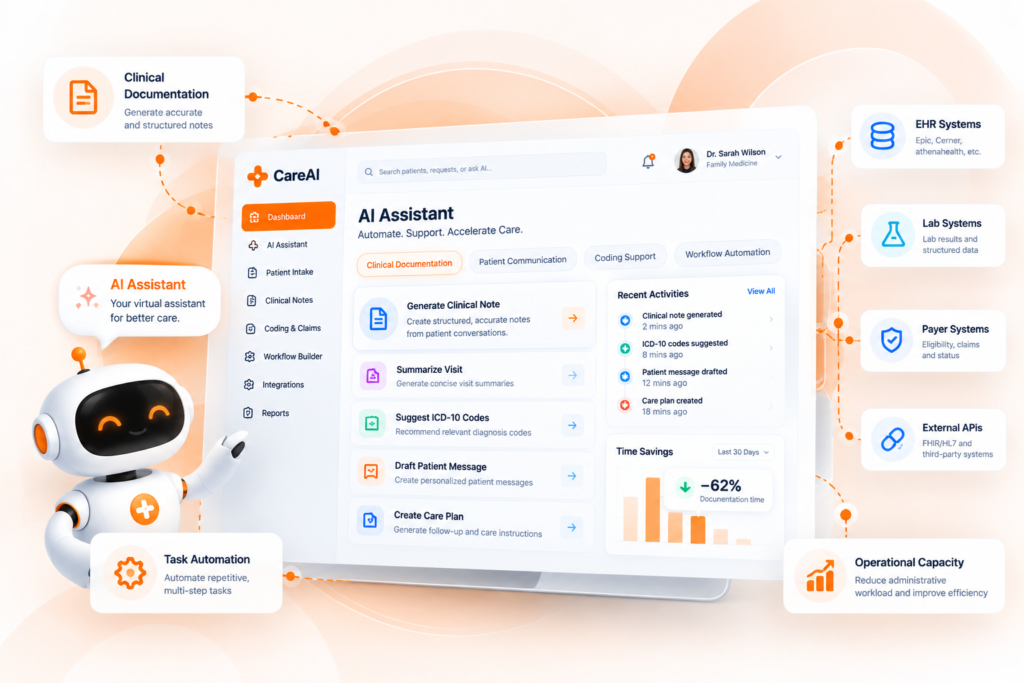
Combine RPA with AI to handle workflows that go beyond fixed rules, from understanding documents and unstructured data to classifying requests and routing exceptions based on context.
- RPA + AI
- Intelligent Document Processing
- NLP
- Decision Intelligence
- Human-in-the-Loop
How We Build
Healthcare Automation
Our healthcare robotic process automation approach moves from workflow discovery and feasibility assessment through
healthcare RPA development, system integration, testing, and production monitoring.
Discover & Prioritize Workflows
Typical timeline: 1–2 weeksWe map the current workflow to identify repetitive tasks, manual handoffs, system dependencies, bottlenecks, and exceptions before deciding what should be automated.
We look at:
- Process steps and task volumes
- Manual data entry and handoffs
- EHR and application touchpoints
- Business rules and decision points
- Processing time and backlogs
- Exception frequency
- Human review requirements
- Expected automation outcomes
A prioritized automation roadmap based on feasibility, operational impact, and implementation complexity.
Define the Automation Approach
Typical timeline: 1–3 weeksWe determine how each workflow should be automated using RPA, APIs, workflow engines, AI-assisted processing, or a combination based on the systems and data involved.
This may include:
- Attended vs. unattended RPA
- UI-based automation
- API-driven automation
- Rules and decision tables
- Queue-based processing
- AI-assisted document handling
- Human-in-the-loop controls
- Exception paths
A defined automation strategy with the right execution method for each workflow step.
Design the Automation Architecture
Typical timeline: 2–4 weeksWe design how automations, workflows, integrations, credentials, queues, and human review points work together across your healthcare technology environment.
We design:
- RPA and workflow architecture
- EHR and payer connectivity
- FHIR, HL7, and API integrations
- Workflow state management
- Secure credential handling
- Transaction logging
- Exception and retry logic
- Access and audit controls
A production-focused automation architecture mapped to your systems, security requirements, and workflow dependencies.
Build & Integrate the Workflows
Typical timeline: 4–10+ weeksWe develop the automation and connect it with the applications, data, and interfaces required to execute the workflow from trigger through completion.
Development can include:
- RPA development
- Workflow engine configuration
- UI and browser automation
- API and EHR integration
- Rules engine implementation
- Document intelligence
- Queue and transaction handling
- Human approval workflows
Working automation integrated with the systems and operational processes required for the target workflow.
Test Workflow & Exception Scenarios
Typical timeline: 2–4 weeksWe test more than the successful path. Automations are validated against system failures, incomplete information, workflow exceptions, duplicate transactions, and scenarios requiring human intervention.
We validate:
- End-to-end execution
- Business rule accuracy
- Data validation
- System response handling
- Retry and recovery behavior
- Exception routing
- Access controls
- Audit trail completeness
A validated workflow that can execute reliably while handling expected failures and exceptions safely.
Deploy, Monitor & Optimize
Typical timeline: OngoingAfter deployment, we track automation execution, transaction queues, failures, processing time, and human intervention to identify where automation performance can improve.
This can include:
- Automation health monitoring
- Queue and transaction monitoring
- Failure diagnostics
- SLA tracking
- Workflow performance analysis
- Automation updates
- Rule changes
- Process optimization
Production automation that remains measurable, maintainable, and adaptable as healthcare systems and workflows change.
Reduce the Cost per Transaction as Workflow Volume Grows
Use RPA, APIs, and workflow orchestration to reduce staff time spent on each claim, authorization, eligibility check, data update, or administrative transaction while processing more work with the same operational capacity.
Why Choose HealthApp Systems
01
Healthcare Automation Expertise
Bring 18+ years of healthcare technology experience into healthcare RPA implementation projects that span EHRs, payer systems, billing platforms, clinical data, and complex operational workflows.
02
Faster Automation Delivery
Move from workflow discovery to production up to 30% faster with reusable integration patterns, experienced healthcare engineers, and a structured automation development approach.
03
Built Around Your Workflow
Design custom healthcare RPA solutions around your existing processes, business rules, exceptions, and human review points instead of forcing operations into rigid preconfigured workflows.
04
Cost-Efficient Automation
Prioritize high-volume, repetitive processes where automation can reduce manual effort and operating costs while avoiding unnecessary infrastructure and maintenance overhead.
05
Cross-System Integration
Automate workflows across EHRs, payer portals, clearinghouses, billing platforms, legacy applications, and APIs without requiring you to replace the systems already in place.
06
Production-Ready Reliability
Build with transaction logging, retry logic, exception queues, credential controls, audit trails, and monitoring so automation remains traceable and manageable in production.
Have a Healthcare
Workflow Challenge We Can Automate?
Share where repetitive work is consuming staff time, and explore how our healthcare workflow automation services can reduce manual processing, increase throughput, and handle growing volumes across your existing systems.
- Reduce manual processing hours
- Increase workflow throughput
- Automate work across existing systems
- Scale without proportional headcount growth
Frequently Asked Questions
The strongest candidates for healthcare process automation services are high-volume, repetitive, rules-driven processes with predictable inputs and measurable outcomes. Eligibility verification, claim status checks, payment posting, reconciliation, referral processing, and routine administrative data movement are common examples.
Processes with frequent exceptions or significant clinical judgment usually need workflow orchestration, human review, or AI-assisted processing rather than pure RPA.
Use APIs when systems expose reliable interfaces for the required data and actions. RPA is useful when workflows depend on payer portals, legacy applications, desktop software, or systems without suitable APIs.
Complex workflows often combine both, with orchestration managing the sequence, state, exceptions, and human approvals across the complete process.
Yes. Healthcare workflow automation solutions can operate across existing EHRs, billing systems, payer portals, clearinghouses, and internal applications using FHIR APIs, HL7 interfaces, vendor APIs, browser automation, desktop automation, or secure file exchange.
The integration approach should be selected system by system rather than forcing every workflow through RPA. Modern healthcare automation platforms are commonly deployed around existing systems of record rather than replacing them.
UI-dependent automation may require updates when page layouts, fields, authentication flows, or application behavior change. API-based integrations are generally less sensitive to interface changes but can still be affected by version or contract changes.
Production automation should include monitoring, resilient selectors where UI interaction is necessary, controlled retries, failure queues, and regression testing around major application upgrades.
Exceptions should be designed as part of the workflow. Missing information, conflicting records, unusual payer responses, and decisions requiring clinical or financial judgment can be routed to a designated work queue with the transaction context preserved.
After review, orchestration can continue from the appropriate workflow state rather than restarting the process. This keeps people responsible for judgment while automation handles predictable processing.
Automation should use least-privilege access, controlled service identities, encrypted connections, secure credential management, and auditable transaction histories.
PHI exposure should be limited to the information required for each workflow. Logs, screenshots, temporary files, and exception records also need controls because automation can unintentionally create additional copies of sensitive information if observability is poorly designed.
Measure the current process before development. Useful inputs include transaction volume, average handling time, labor cost, error and rework rates, backlog, turnaround time, exception frequency, and system touchpoints.
Then compare the expected capacity and cost savings against development, platform licensing, infrastructure, maintenance, monitoring, and exception-handling costs. High-volume processes with stable rules generally produce a clearer automation business case.
Major cost drivers include workflow complexity, number of applications involved, transaction volume, integration methods, exception paths, document processing requirements, security controls, and the selected automation platform.
Total cost should also include platform licensing, runtime infrastructure, monitoring, application-change maintenance, and support—not just initial healthcare RPA implementation.
Evaluate the platform against your workflow portfolio, existing technology stack, orchestration requirements, unattended execution needs, governance model, deployment environment, integration options, licensing, and internal engineering skills.
Large automation programs may benefit from centralized enterprise platforms. API-first or custom healthcare RPA solutions can be more appropriate for specific product workflows. A healthcare organization can also use multiple approaches rather than standardizing every process on one tool.
AI is useful when a workflow contains information that fixed rules cannot reliably interpret, such as variable documents, free text, incoming requests, or other unstructured data.
AI can extract or classify the information and pass the result into a controlled workflow. Confidence thresholds and human review can be applied where necessary. Predictable system actions should remain deterministic rather than using AI where conventional automation is sufficient.
Testing should cover the complete workflow, including duplicate records, missing data, authentication failures, application timeouts, unavailable downstream systems, retry scenarios, and human-review paths.
For workflows that update EHRs, billing systems, or payer portals, duplicate-prevention and transaction-state controls are particularly important. Production readiness should also include rollback procedures, monitoring, and a defined manual fallback when automation is unavailable.
Production automation requires ongoing monitoring, application-change management, credential maintenance, workflow updates, exception analysis, and performance review.
Ownership should be defined across IT, operations, process owners, and the automation team. As transaction volumes and systems change, workflows may need optimization or redesign. Mature automation programs therefore manage automations as production applications rather than one-time scripts.