Healthcare AI Development
Build Healthcare AI Around Your Workflows 2X Faster & Cut Manual Work by 40%
We design and build custom healthcare AI solutions around your clinical and operational workflows, from intelligent automation and predictive models to generative AI and AI agents, integrated with your EHR, data, and existing healthcare systems.
Healthcare AI
Development Capabilities
AI-Powered Application Development
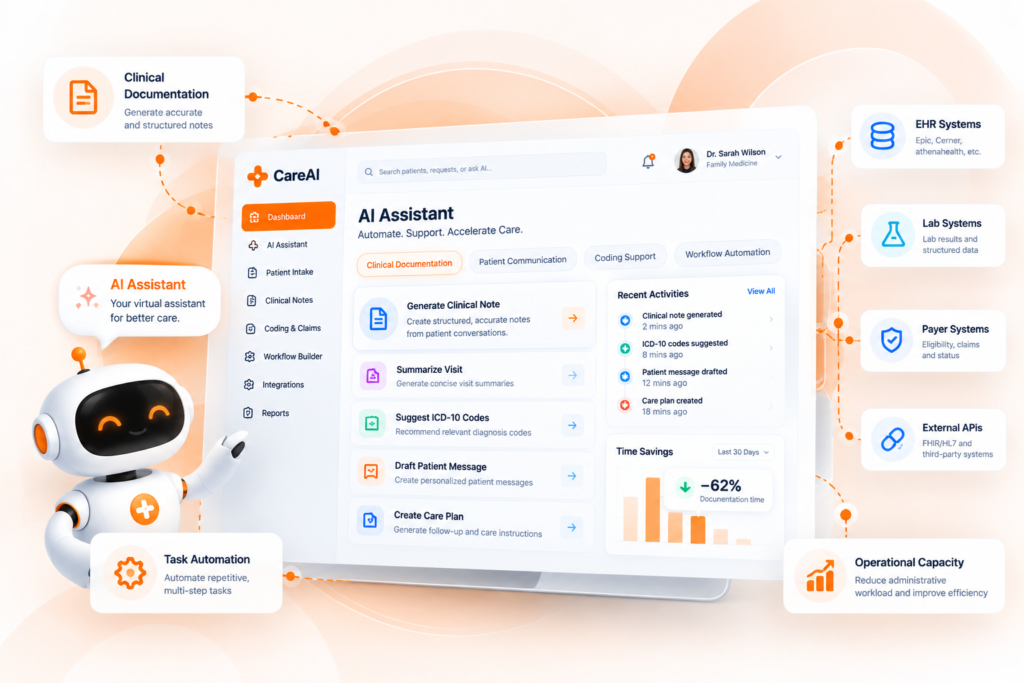
Build AI applications for healthcare for summarization, information extraction, intelligent search, content generation, and decision support using the right models and healthcare data.
Predictive Intelligence
Use clinical, operational, and financial data to identify patterns, estimate risk, forecast outcomes, and support data-driven healthcare decisions.
Clinical NLP
Transform clinical notes, reports, messages, and other unstructured healthcare content into structured information that applications and workflows can use.
Intelligent Workflow Automation
Apply healthcare AI workflow automation to documentation, intake, billing, patient communication, and administrative workflows where repetitive analysis or manual processing slows teams down.
Healthcare Data Intelligence
Prepare and connect structured and unstructured healthcare data so AI applications can retrieve relevant information and produce more reliable outputs.
Production AI Engineering
Move AI from prototype to production with secure healthcare AI integration, model deployment, monitoring, performance controls, and scalable infrastructure.
Healthcare AI Software
We Build for Your Business
-
For Healthcare Organizations
-
For Digital Health & HealthTech
Companies -
For Clinical, Diagnostic &
Data Teams
Clinical AI Applications
Build AI into clinical workflows to reduce documentation effort, surface relevant patient information faster, and support better-informed decisions without adding more steps to the clinician’s existing workflow.
Administrative & Operational AI
Reduce time spent reviewing documents, processing requests, and handling repetitive administrative work by applying AI to high-volume workflows while keeping exceptions and sensitive decisions with staff.
Patient Access & Engagement AI
Improve how patients access information and complete routine interactions with AI-powered intake, navigation, education, and communication experiences that reduce repetitive work for front-office teams.
Revenue Cycle AI
Use AI across coding, claims, denials, authorizations, and financial workflows to reduce manual review, identify issues earlier, and help revenue cycle teams focus on accounts that require intervention.
AI-Powered Healthcare Products
Embed AI directly into digital health products to introduce intelligent search, summarization, prediction, and decision-support capabilities without rebuilding the core product or disrupting existing user workflows.
Healthcare AI APIs & Services
Build reusable AI services that bring NLP, extraction, summarization, classification, and predictive capabilities into existing healthcare products without developing separate AI functionality for every application.
Generative AI Applications
Turn healthcare data, documents, and enterprise knowledge into grounded generative AI for healthcare experiences that help users find information, summarize complex content, and complete knowledge-intensive work faster.
Healthcare NLP & Document Intelligence
Convert clinical notes, reports, referrals, forms, and other unstructured healthcare content into structured, usable data while reducing the manual effort required to review and process documents.
Healthcare Data Intelligence
Bring fragmented clinical, operational, and financial data together to uncover patterns, surface actionable insights, and support decisions that conventional dashboards and static reporting may not reveal.
Predictive Healthcare AI
Use historical and real-time healthcare data to identify risk, forecast demand, and detect meaningful patterns earlier, giving clinical and operational teams better information for planning and intervention.
Engineer the Right AI Stack
for Your Healthcare Use Case
Choose the right model, data approach, healthcare AI architecture, integration path, and deployment strategy based on your workflow, accuracy requirements, healthcare data, and production environment.
- LLM & ML Model Selection
- RAG & Knowledge Grounding
- Data Readiness
- FHIR & API Integration
- Deployment Strategy
How We Build
Healthcare AI Solutions
Define the AI Use Case & Success Criteria
Typical timeline: 1–2 weeksWe start by identifying where AI can create measurable value, what decisions or tasks it needs to support, and how success should be measured.
We look at:
- Clinical and operational workflows
- Current manual processes and bottlenecks
- Target users and AI interactions
- Available healthcare data
- Existing applications and systems
- Accuracy and performance requirements
- Human review requirements
- Business and workflow outcomes
A prioritized AI use case with defined scope, feasibility requirements, and measurable success criteria.
Assess Data & Select the AI Approach
Typical timeline: 2–4 weeksWe evaluate the data available for the use case and determine whether the solution requires an LLM, RAG, predictive model, NLP pipeline, or a combination of AI approaches.
We look at:
- Structured and unstructured data
- Data quality and completeness
- Clinical terminology and context
- RAG and knowledge grounding
- Model selection
- Training or fine-tuning requirements
- PHI and data-access controls
- Evaluation datasets
A defined AI strategy covering data readiness, model approach, grounding, security, and evaluation requirements.
Design the AI Solution
Typical timeline: 2–4 weeksWe design how the AI layer will process data, generate or predict outputs, connect with healthcare systems, and operate within defined clinical and operational boundaries.
We design:
- Healthcare AI architecture
- Data and retrieval pipelines
- Prompt and context management
- FHIR and API integrations
- Application workflows
- Security and access controls
- Human review points
- Logging and observability
A production-focused technical design connecting the AI, healthcare data, application, and integration layers.
Develop & Integrate the AI
Typical timeline: 6–12+ weeksWe build the AI application and integrate it with the healthcare data, workflows, and systems required to deliver the intended outcome in real-world use.
Development can include:
- LLM and generative AI integration
- Healthcare RAG development
- Predictive model development
- Clinical NLP
- Healthcare data pipelines
- EHR and FHIR integration
- Application and API development
- Workflow automation
A working healthcare AI solution integrated with the systems and data required for the target workflow.
Validate Accuracy, Safety & Performance
Typical timeline: 2–4+ weeksBefore production, we test AI outputs against representative healthcare scenarios and validate how the application behaves when data is incomplete, ambiguous, or outside its expected scope.
We validate:
- Model and output accuracy
- Hallucination and grounding behavior
- Clinical terminology handling
- Retrieval quality
- Workflow execution
- PHI and access controls
- Integration failures
- Human review and fallback paths
A validated AI application with measurable performance, defined safeguards, and tested production workflows.
Deploy, Monitor & Improve
Typical timeline: OngoingAfter deployment, we monitor how the AI performs with real workloads and identify changes in accuracy, usage, data, latency, cost, and workflow outcomes.
This can include:
- Production deployment
- Model performance monitoring
- Accuracy and quality tracking
- Drift detection
- Latency and inference monitoring
- Usage and cost monitoring
- Model or prompt optimization
- Knowledge and data updates
A production-ready healthcare AI solution that can be measured, maintained, and improved as data, workflows, and requirements evolve.
Stop Overspending on AI That Your Workflow Doesn’t Need
Build healthcare AI around the right models, data, and infrastructure for your use case, reducing unnecessary development, inference, and cloud costs while keeping the solution ready to scale.
Why Choose HealthApp Systems
01
Healthcare Expertise
Bring 18+ years of healthcare technology experience into healthcare AI development services, combining healthcare workflows, clinical data, interoperability, and AI engineering to build solutions that fit real healthcare environments.
02
Faster AI Development
Achieve up to 30% faster development cycles with experienced healthcare engineers, reusable AI components, proven integration patterns, and a structured path from use-case validation to production.
03
Flexible AI Stack
Choose the models, cloud platforms, data architecture, and AI technologies that fit your use case without designing the solution around a single model or vendor ecosystem.
04
Cost-Efficient AI Engineering
Control development and ongoing AI costs by selecting the right models, infrastructure, data pipelines, and inference approach for your workload instead of overengineering the solution.
05
Healthcare System Integration
Connect AI with EHRs, clinical applications, data platforms, and existing workflows through FHIR, HL7, APIs, and secure healthcare data pipelines.06
Security & Compliance
Build AI applications with PHI protection, access controls, auditability, data governance, human oversight, and healthcare security requirements incorporated throughout development.
Have a Healthcare AI
Use Case in Mind?
Tell us what you want AI to predict, generate, analyze, or automate, and our healthcare AI team will help define a practical path from your data and use case to production – no commitment required.
- LLM, RAG & predictive AI development
- Clinical NLP & healthcare data intelligence
- Model validation & performance testing
- Production deployment & ongoing monitoring
Frequently Asked Questions
AI works best in workflows that involve high manual effort, large volumes of data, repetitive analysis, or decisions that can be supported by measurable patterns. Common use cases include clinical documentation, record summarization, coding support, patient intake, document processing, care-gap identification, and operational forecasting.
The right starting point is a workflow with a clearly defined problem, accessible data, and a measurable outcome.
Build custom healthcare AI solutions when proprietary workflows, data, integrations, or product differentiation require greater control. Existing platforms may be sufficient for standardized capabilities.
A hybrid approach is also common: use established AI models while owning the healthcare integrations, validation, workflow logic, security controls, and user experience.
Healthcare data is AI-ready when it is accessible, sufficiently complete, correctly mapped, governed, and representative of the intended use case.
Readiness should consider data quality, missing information, terminology, provenance, permissions, and historical consistency. Requirements vary significantly between use cases such as document classification, generative AI, and clinical prediction.
It depends on what the application needs to accomplish. RAG works well when AI needs current information from controlled knowledge sources. Fine-tuning is useful when model behavior or task-specific performance needs adjustment. Custom models may be justified for proprietary prediction problems or specialized data.
These approaches can also work together. A healthcare application might combine a foundation model, RAG, deterministic rules, and workflow-specific validation rather than relying on one technique.
Healthcare AI integration can use FHIR APIs, HL7, SMART on FHIR, vendor APIs, integration engines, or custom services.
The architecture should separately control data retrieval and system actions. Authentication, authorization, provenance, validation, error handling, and audit logging become especially important when AI can write information back or trigger actions within clinical systems.
Hallucinations can be reduced by grounding responses in approved data, limiting what the model can answer, validating outputs, and requiring human review where appropriate.
RAG, structured outputs, deterministic rules, source attribution, and validation layers provide additional controls. When reliable evidence is unavailable or a request falls outside the approved scope, the system should abstain or escalate rather than generate an unsupported answer.
Validation should reflect the actual population, data, workflow, and intended use rather than relying only on generic model benchmarks.
Depending on the application, testing may measure accuracy, precision, recall, retrieval quality, hallucination rate, subgroup performance, or workflow completion. Higher-risk outputs should include clinical or domain review. Testing should also cover incomplete data, unusual inputs, integration failures, and other realistic failure conditions before production deployment.
Potentially, but the complete technical and contractual environment must support the organization’s HIPAA obligations and intended PHI use.
Organizations should evaluate data transmission, storage, retention, subprocessors, access controls, logging, and applicable business associate arrangements. Architecture should also minimize unnecessary PHI exposure through approaches such as data filtering, de-identification, private endpoints, controlled model gateways, or private deployment where appropriate.
Cost depends on the use case, data preparation, model strategy, integrations, validation, infrastructure, and security requirements.
Budgeting should also account for ongoing model inference, cloud compute, data pipelines, monitoring, retraining, and integration maintenance. Estimating the complete production solution provides a more realistic cost than pricing AI model development alone.
Choose based on the task, accuracy requirements, latency, data sensitivity, context size, deployment environment, and operating cost—not simply model size.
Different tasks may use different models within one application. Model selection should be validated against representative healthcare data and predefined performance criteria before production use.
Not always. Healthcare AI can run in managed cloud, private cloud, dedicated, on-premises, or hybrid environments.
The right approach depends on PHI handling, security policy, latency, integrations, vendor agreements, audit requirements, and internal infrastructure. Deployment architecture should follow the organization’s actual data and governance requirements rather than defaulting to one environment.
Monitor the metrics that matter to the specific AI use case, such as accuracy, retrieval quality, hallucination rate, model or data drift, latency, failed integrations, human overrides, and corrections.
Models, prompts, knowledge sources, and evaluation datasets should also be versioned so teams can identify what changed when production performance moves outside expected thresholds.