
Healthcare Virtual Assistant Development
Handle 2X More Patient Requests with Healthcare Virtual Assistants
We build healthcare virtual assistants that automates patient inquiries, appointment workflows, intake, follow-ups, and care coordination keeping your workflows, integrations, data security, and compliance requirements built into every interaction.
The Capabilities Behind Intelligent
Healthcare Virtual Assistants
Patient Conversation Intelligence
Handle multi-step patient conversations with persistent context, intent changes, workflow boundaries, and defined escalation when human intervention is required.
EHR & Clinical System Integration
Enable assistants to securely retrieve permitted data and execute approved actions across EHRs, scheduling platforms, patient portals, and other clinical systems.
Patient Access Automation
Automate transactional patient workflows while validating required information, checking system availability, and maintaining state across each interaction.
Clinical & Administrative Assistance
Support staff with assistants that retrieve relevant information, prepare workflow inputs, initiate approved tasks, and escalate exceptions instead of automating clinical decisions.
Secure Healthcare AI Architecture
Control how PHI enters the assistant, which systems and data it can access, what actions it can execute, and how every interaction is recorded.
Multi-Channel Virtual Assistance
Maintain patient identity, conversation context, and workflow state as interactions move across digital and voice channels.
Practice Management
Products We Build
-
Patient Access Virtual
Assistants -
For Clinical & Care Teams
-
For Billing & Revenue
Cycle Teams -
For Connected
Healthcare Operations
Patient Access Virtual Assistants
Give patients a faster way to complete routine requests without waiting for front-office staff. Virtual assistants can handle scheduling, registration, referrals, and common access workflows while routing exceptions with the patient context already captured.
Insurance & Eligibility Virtual Assistants
Move repetitive coverage questions away from front-office and billing queues. Assistants can collect insurance details, initiate eligibility checks, surface permitted coverage information, and direct unresolved issues to staff before they delay the visit.
Intake & Pre-Visit Virtual Assistants
Complete more of the administrative work before the patient arrives. Assistants collect required information, identify missing fields, guide patients through pre-visit requirements, and push structured data into connected workflows instead of leaving staff to re-enter it.
Clinical Workflow Virtual Assistants
Reduce the small administrative tasks that repeatedly interrupt clinical work. Assistants can retrieve permitted information, prepare workflow inputs, create tasks, and surface relevant patient context while keeping clinical decisions with qualified care teams.
Care Coordination Virtual Assistants
Keep routine coordination work moving without requiring staff to manually track every patient interaction. Assistants support follow-ups, referrals, care-plan activities, and outstanding tasks while escalating patients who require direct clinical attention.
Patient Billing Virtual Assistants
Help patients resolve routine billing questions without adding another manual touchpoint for RCM teams. Assistants can surface permitted balance information, explain payment workflows, support statement inquiries, and route account-specific issues to billing staff.
Revenue Cycle Virtual Assistants
Reduce the repetitive lookup, status-checking, and task-routing work surrounding the revenue cycle. Assistants bring relevant claim and account information into one workflow and direct exceptions to staff who can take the next action.
Patient Engagement Virtual Assistants
Keep routine patient communication available beyond office hours without turning every interaction into a staff task. Assistants can answer approved questions, guide patients through next steps, trigger follow-ups, and maintain context across the patient journey.
EHR-Connected Virtual Assistants
Turn patient and staff conversations into usable workflow actions instead of another source of manual entry. We connect assistants with EHRs and operational systems so permitted information can be retrieved, tasks created, records updated, and downstream workflows triggered securely.
Context-Aware AI for
Complex Patient Workflows
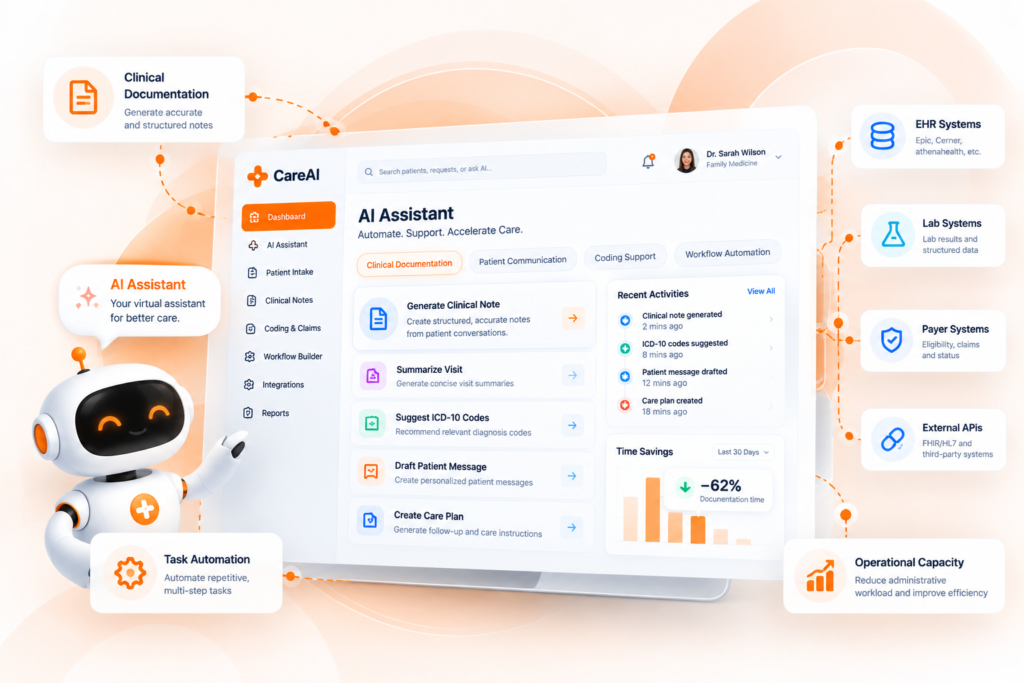
Build a healthcare AI virtual assistant that understands patient intent, retains context across interactions, retrieves relevant information, and triggers the right action across connected healthcare systems.
- Patient Intent
- Context Memory
- Knowledge Retrieval
- Workflow Orchestration
- EHR/FHIR Integration
How We Build
Healthcare Virtual Assistants
Define the Assistant Use Cases & Workflow Boundaries
Typical timeline: 1–2 weeksWe identify where a virtual assistant can remove repetitive work without introducing unnecessary risk or another disconnected patient experience.
We look at:
- Patient and staff use cases
- High-volume repetitive workflows
- User intents and requests
- EHR and system touchpoints
- Data the assistant needs to access
- Actions it can perform
- Clinical and administrative boundaries
- Human escalation requirements
A prioritized healthcare virtual assistant roadmap defining what to automate, what to integrate, and where human intervention remains necessary.
Design the Virtual Assistant Architecture
Typical timeline: 2–4 weeksWe design how the assistant understands requests, maintains context, retrieves approved information, and executes actions across your healthcare environment.
This may include:
- Conversational AI architecture
- LLM and orchestration layer
- Intent and context management
- Knowledge retrieval architecture
- Tool and function calling
- EHR and API connectivity
- Authentication and authorization
- Session and audit management
A Healthcare AI assistant architecture connecting conversational intelligence with the systems required to complete real workflows.
Build Conversation Logic & Knowledge Grounding
Typical timeline: 2–4 weeksHealthcare users rarely phrase the same request the same way. We design the assistant to understand variations in intent while grounding responses in approved information and controlling what happens when a request falls outside its scope.
This includes:
- Intent classification
- Multi-turn conversation flows
- Context persistence
- RAG and knowledge retrieval
- Approved knowledge sources
- Response boundaries
- Confidence thresholds
- Human escalation logic
A grounded healthcare intelligent virtual assistant that can handle real conversations without relying on unrestricted responses or rigid decision trees.
Develop & Integrate the Virtual Assistant
Typical timeline: 6–12+ weeksOur healthcare virtual assistant developers connect the conversational layer to the systems where the actual work happens, allowing the assistant to move beyond answering questions.
Depending on the use case, development can include:
- Appointment scheduling
- Digital patient intake
- Eligibility workflows
- Referral management
- Patient portal assistance
- Care coordination workflows
- Billing and payment support
- EHR and practice management integration
- Custom healthcare APIs
A working healthcare virtual assistant that can retrieve information, initiate approved actions, and complete workflows across connected systems.
Validate Accuracy, Security & Workflow Execution
Typical timeline: 2–4+ weeksBefore deployment, we test both what the assistant says and what it does. This includes verifying that system actions, patient data access, escalation rules, and responses behave correctly across normal and exception scenarios.
We validate:
- Intent recognition
- Response accuracy
- Knowledge retrieval
- Patient authentication
- Role-based access
- EHR/API transactions
- PHI handling
- Failed workflow scenarios
- Human handoffs
- Audit trails
A validated assistant with tested responses, integrations, permissions, and escalation paths before patient or staff adoption.
Deploy, Monitor & Expand
Typical timeline: OngoingOnce live, we monitor where users succeed, where conversations break down, and which requests continue to require manual intervention. Those signals help determine what should be tuned or automated next.
This can include:
- Production monitoring
- Conversation analytics
- Unresolved-intent analysis
- Workflow completion tracking
- Response and retrieval tuning
- Knowledge-base updates
- New workflow automation
- Integration maintenance
- Security updates
A production-ready healthcare virtual assistant that can expand into additional workflows without rebuilding the underlying architecture.
Your Patient Volume Shouldn’t Dictate Your Support Costs
Reduce support costs as patient volume grows by automating routine scheduling, intake, billing, and follow-up interactions without adding staff at the same rate.
Why Choose HealthApp Systems
01
Healthcare Expertise
Leverage 18+ years of healthcare technology experience across patient workflows, clinical operations, EHR environments, and healthcare virtual assistant development.
02
Experience Design
Design contextual patient and staff interactions with intuitive conversations, workflow continuity, accessible experiences, and smooth human handoffs.
03
Compliance Engineering
Protect PHI through authentication, role-based access, encryption, consent controls, audit trails, and healthcare-focused AI governance.
04
Integration Depth
Connect assistants with EHRs, scheduling, billing, patient portals, and healthcare systems through FHIR, HL7, APIs, and workflow-specific integrations.
05
Cost Efficiency
Reduce repetitive workflow effort by up to 40% through targeted automation of high-volume patient and administrative interactions.06
Faster Delivery
Achieve up to 30% faster development cycles using healthcare-focused engineering, reusable integration components, and proven implementation patterns.
Ready to Build a
Healthcare Virtual Assistant?
Share the workflows you want to automate, and our healthcare technology experts will help define the right assistant, integrations, and implementation approach for your organization – no commitment required.
- Patient & staff workflow automation
- EHR, scheduling & billing integration
- Context-aware conversational AI
- Healthcare-grade security & PHI controls
Frequently Asked Questions
The cost of healthcare virtual assistant development depends mainly on workflow complexity, EHR integration, AI model usage, security requirements, supported channels, and the number of actions the assistant needs to perform. A scheduling assistant is considerably simpler than one coordinating intake, eligibility, billing, and clinical workflows.
Integration depth is often a major cost driver. Projects requiring FHIR APIs, proprietary EHR interfaces, identity verification, RAG, audit logging, and multiple healthcare systems require more engineering and validation than standalone conversational assistants.
A focused healthcare virtual assistant can typically move from discovery to an initial production release in 8–16 weeks, while complex enterprise implementations may take longer. The timeline depends heavily on integration access, workflow complexity, security review, and validation requirements.
A practical implementation usually progresses through workflow discovery, architecture, conversation design, EHR/API integration, testing, and controlled deployment. Projects involving several EHRs, payer systems, patient portals, or complex approval workflows should be planned as phased implementations rather than one large release.
Yes. A healthcare virtual assistant can connect with existing EHRs and EMRs when the required integration interfaces are available. FHIR APIs, HL7 interfaces, vendor APIs, SMART on FHIR, and custom integration services may be used depending on the platform and workflow.
The important distinction is between reading information and performing actions. Retrieving appointment details may be straightforward, while creating appointments, updating records, or initiating workflows requires appropriate permissions, API capabilities, validation, and audit controls.
HIPAA compliance must cover the entire PHI data flow, not simply the AI model. Authentication, role-based access, encryption, minimum-necessary data access, audit logging, retention policies, vendor BAAs, and secure integrations all need to be addressed based on how the assistant handles protected health information.
The architecture should also define what information can reach the model, where conversations are stored, which systems the assistant can access, and what actions it can execute. Compliance therefore becomes an architectural and operational requirement rather than a feature added before launch.
Healthcare virtual assistants should ground sensitive responses in approved organizational data rather than unrestricted model knowledge. Retrieval-augmented generation (RAG) can retrieve relevant content from controlled knowledge bases, policies, FAQs, and other validated sources before a response is generated.
That alone is not enough. Production systems should also use response boundaries, confidence thresholds, structured workflows, source controls, validation testing, and escalation rules. Requests involving uncertain information or clinical judgment should move to an appropriate human workflow instead of forcing the model to generate an answer.
Healthcare virtual assistants can automate well-defined workflows such as appointment scheduling, patient intake, eligibility inquiries, referral status, billing questions, follow-ups, reminders, patient navigation, and routine portal support. They can also assist staff with information retrieval and task initiation.
The best candidates are high-volume workflows with predictable rules, accessible system data, and clear outcomes. Workflows involving clinical interpretation, unusual exceptions, or decisions requiring licensed judgment need stronger boundaries and human oversight rather than unrestricted automation.
A properly integrated virtual assistant can perform approved EHR actions, not just answer questions. Depending on the EHR’s available APIs and permissions, the assistant may create appointments, update selected patient information, initiate tasks, retrieve status information, or trigger downstream workflows.
These actions should run through a controlled execution layer rather than giving the AI unrestricted system access. Each function needs defined permissions, input validation, authentication, error handling, and audit logging so organizations can determine exactly what the assistant changed and why.
Human escalation should be designed into the workflow from the beginning. The assistant needs explicit rules for requests involving clinical judgment, low-confidence responses, authentication failures, patient distress, unusual billing issues, system errors, or situations outside its approved scope.
A good handoff preserves context. Instead of making the patient repeat the conversation, the assistant can transfer the relevant interaction history, collected information, completed steps, and unresolved issue to the appropriate staff member. This makes human intervention part of the workflow rather than a failure state.
A custom healthcare AI assistant makes more sense when the organization has proprietary workflows, multiple healthcare integrations, specific security controls, specialty requirements, or actions that standard assistants cannot support. Off-the-shelf platforms can be sufficient for narrower use cases such as basic FAQs or simple appointment requests.
The decision should be based on workflow fit rather than AI features alone. Evaluate integration access, customization limits, PHI handling, data ownership, model flexibility, auditability, ongoing usage costs, and whether the platform can execute the workflows the organization actually needs.
A healthcare virtual assistant should use approved, current, and workflow-relevant information. Typical sources include patient-facing FAQs, scheduling policies, provider information, operational procedures, billing guidance, referral rules, and permitted EHR data retrieved at runtime.
Not every implementation requires model fine-tuning. For frequently changing healthcare information, RAG and controlled API retrieval are often more practical because the assistant can reference current sources without embedding every update into the model. Source ownership, update frequency, access permissions, and validation should be defined before deployment.
Testing should cover both conversation accuracy and workflow execution. Teams need to evaluate intent recognition, multi-turn context, knowledge retrieval, authentication, EHR transactions, permissions, escalation behavior, PHI handling, integration failures, and unexpected patient inputs.
Testing should also include edge cases rather than only ideal conversations. Misspelled information, incomplete requests, conflicting data, unavailable APIs, repeated questions, and out-of-scope clinical requests reveal how the assistant behaves under real operating conditions. Higher-risk workflows should receive additional domain and compliance review before production access.
Measure the assistant against the workflow it was designed to improve. Useful metrics include workflow completion rate, containment rate, escalation rate, unresolved intents, response accuracy, task completion time, integration failures, patient abandonment, and staff interventions.
Avoid treating conversation volume as the primary success metric. A high-volume assistant can still create more work if patients frequently require correction or staff intervention. Production monitoring should show which workflows finish successfully, where conversations fail, why handoffs occur, and which use cases are ready for further automation.