
Practice Management Software Development Company
Automate 40% of Repetitive Practice Tasks With One Connected Platform
Build a custom practice management platform around scheduling, patient access, provider operations, billing, and revenue cycle, connecting the systems your practice relies on to reduce manual work without the limitations of rigid off-the-shelf software.
The Capabilities Behind Better
Practice Management
Workflow Engineering
Design practice management software solutions around scheduling rules, clinical handoffs, staff responsibilities, and the way work actually moves across the practice.
Provider Operations
Manage provider availability, locations, specialties, schedules, and operational constraints without relying on manual coordination.
Patient Flow
Connect the steps from appointment scheduling through visit preparation and follow-up without making staff work across disconnected systems.
Revenue Integration
Connect front-office activity with billing processes so eligibility, charges, claims, and payments are based on the right operational data.
System Connectivity
Make the practice management platform development work with the EHR, payer systems, labs, and other systems already in the practice environment.
Practice Configuration
Support specialty-specific rules, locations, provider structures, scheduling models, and administrative requirements without hard-coding every change.
Practice Management
Products We Build
Connected Products for Daily Practice Operations
Bring patient access, clinical workflows, billing, and practice operations into connected systems built around how medical practices work every day.
Patient & Front Office Products
Connect the first patient interaction through appointment and insurance preparation in one practical workflow. Reduce repetitive front-office work while giving staff better visibility into what needs to happen before the visit.
Products include:Clinical & Provider Products
Keep provider schedules, patient information, documentation, and clinical workflows connected to the practice's daily operations. Give care teams the information they need without making them move between disconnected systems.
Products include:Billing & Revenue Cycle Products
Connect charges, claims, payments, denials, and receivables with the operational data that drives the revenue cycle. Improve billing visibility and reduce the manual handoffs that can lead to delays, rework, and missed revenue.
Products include:Practice Infrastructure Built for Growth
Support expanding practices with connected operational, administrative, and reporting systems that provide better control across providers, locations, and business functions.
Practice Operations Products
Give administrators better control over providers, staff, resources, locations, and recurring practice workflows. Support consistent operations across locations while allowing each practice or specialty to maintain its own operating requirements.
Products include:Reporting & Analytics Products
Bring clinical, operational, and financial information together so practice leaders can see where performance is changing and where attention is needed. Replace scattered reports with decision-ready information across providers, locations, and revenue-cycle operations.
Products include:Connected Patient Experiences and Healthcare Integrations
Improve patient access and reduce disconnected work by connecting communication, digital services, clinical systems, payers, and external healthcare platforms.
Patient Engagement Products
Make routine patient interactions easier through connected digital experiences before, during, and after the visit. Reduce avoidable calls and manual follow-ups while giving patients more convenient ways to communicate and complete routine tasks.
Products include:Healthcare Integration Products
Connect practice management workflows with the healthcare systems already in use, reducing duplicate entry and disconnected information. Keep scheduling, clinical, billing, and external healthcare data moving between the systems that staff rely on every day.
Products include:AI-Powered Intelligence
for Practice Operations
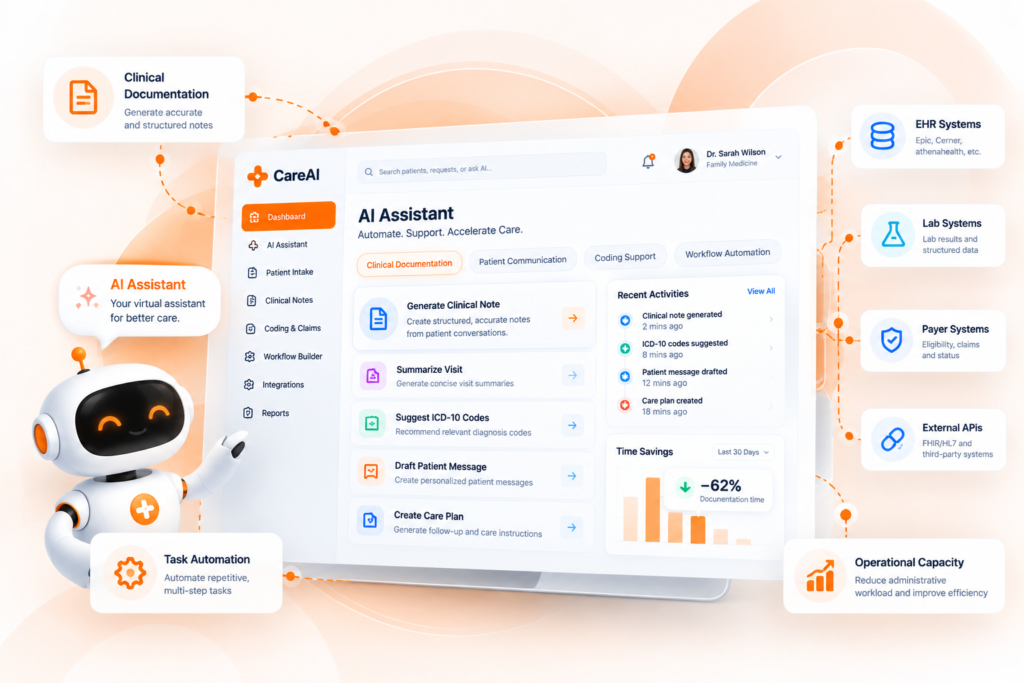
Use AI to identify workflow patterns, reduce repetitive administrative work, and support better decisions across scheduling, patient engagement, and practice operations.
- Predictive Scheduling
- Practice Insights
- Workflow Intelligence
- Patient Engagement
- Revenue Analytics
How We Build
Practice Management Software
Map the Practice Workflow
Typical timeline: 1–3 weeksWe first understand how work moves through the practice, from scheduling and patient access to visits, billing, claims, payments, and reporting.
We look at:
- Patient access workflows
- Provider scheduling models
- Front-office operations
- Billing and revenue workflows
- Specialty-specific requirements
- Multi-location operations
- Existing systems and integrations
A clear workflow map, requirements, priorities, and development roadmap.
Design the Practice Experience
Typical timeline: 2–4 weeksThe system is designed around the different teams using it, from front-office staff and providers to billing teams and administrators.
This can include:
- Scheduling workflows
- Patient communication journeys
- Provider workflows
- Billing team workflows
- Administrative dashboards
- Role-based user experiences
A practical medical practice management software development experience built around how your teams actually work.
Plan the System Architecture
Typical timeline: 2–4 weeksWe define how the healthcare practice management system development approach will manage users, operational data, workflows, and connections with healthcare systems.
This may include:
- Practice and user hierarchy
- Data models
- Workflow engine design
- EHR/EMR connectivity approach
- FHIR and HL7 requirements
- Integration strategy
- Access and permission model
A technical foundation that connects practice operations, clinical systems, and revenue workflows.
Develop the Practice Platform
Typical timeline: 8–16+ weeksDevelopment focuses on the priority workflows your practice needs rather than building every possible module at once.
Depending on scope, this can include:
- Appointment scheduling
- Patient access workflows
- Eligibility workflows
- Billing workflows
- Claims processing
- Provider management
- Patient communication
- Operational reporting
A working practice management platform ready for integration and workflow validation.
Integrate & Validate
Typical timeline: 3–8+ weeksThe system is connected and tested against the healthcare applications and revenue-cycle systems your organization depends on.
Validation can cover:
- EHR/EMR connectivity
- FHIR APIs
- HL7 interfaces
- Payer connectivity
- Clearinghouse integrations
- Laboratory connections
- ePrescribing workflows
- Telehealth connections
- Billing workflow validation
A connected practice management system that works across the required operational and healthcare environment.
Launch & Optimize
Typical timeline: OngoingOnce the system is in production, improvements are driven by operational needs, user feedback, practice growth, and changing healthcare requirements.
Support can include:
- Workflow optimization
- New module development
- Additional integrations
- Reporting improvements
- Specialty workflow enhancements
- Platform modernization
A practice management system that continues to adapt as your organization grows.
Build the Right Practice Software Investment
Avoid spending on unnecessary features and complex systems that do not match your operational needs. Define the right workflows, prioritize essential capabilities, and build a custom practice management software solution that grows with your organization.
Why Choose HealthApp Systems
Healthcare Expertise
8+ Years8+ years of healthcare software experience across practice workflows, EHR integrations, interoperability, and clinical technology requirements.
Faster Launch
Up to 30% FasterReduce development cycles by up to 30% with healthcare-focused engineering practices, and a team experienced in practice management software development solutions.
Cost Efficiency
Lower Technology OverheadControl development costs by accessing specialized healthcare engineering expertise without expanding internal teams or managing additional technology overhead.
Smart Integrations
HL7 · FHIR · APIsConnect EHRs, payers, labs, clearinghouses, and healthcare platforms through proven HL7, FHIR, and API integration expertise.
Specialty Focus
Built Around Your PracticeBuild custom medical practice management software tailored to specialty workflows, provider models, locations, and operational requirements.
Quality Assurance
Validated Before LaunchImprove release confidence through structured validation of workflows, integrations, and user experiences before production.
Is Your Practice
Software Limiting Your Growth?
If your current systems create workflow gaps, manual tasks, or integration challenges, we help design practice management software around the way your organization operates.
- Scheduling and patient workflow optimization
- Billing and revenue cycle integration
- EHR, HL7 & FHIR connectivity
- Specialty and multi-location support
Frequently Asked Questions
There is no useful flat price for custom healthcare software. In our experience, the biggest cost drivers are the number of workflows, EHR or third-party integrations, data migration, user roles, security requirements, and whether the application needs to support multiple organizations.
A provider portal and a multi-tenant healthcare platform can have very different engineering requirements. We typically scope the architecture, integrations, functionality, and delivery phases first, then estimate the project based on the actual requirements.
The timeline depends more on what the software needs to connect to and do than on the number of screens. A focused application can move to an initial release in a few months, while an enterprise healthcare platform may require a longer phased rollout.
EHR integrations, complex clinical workflows, data migration, security requirements, and testing can all add time. Defining the MVP and technical architecture early helps separate what needs to launch first from what can follow.
Yes. We work with both FHIR-based APIs and HL7 interfaces depending on the systems and data being exchanged. The important part is not simply connecting an endpoint; the integration needs to handle authentication, data mapping, message validation, error handling, and the specific workflow behind the exchange.
FHIR is commonly used for modern API-based connectivity, while HL7 remains important across many established healthcare environments.
Yes. Custom applications can integrate with existing EHRs through FHIR APIs, HL7 interfaces, SMART on FHIR, vendor APIs, or other supported connectivity options.
The approach depends on the EHR and what information needs to move between systems. For example, an application may need patient demographics, encounters, medications, clinical observations, or scheduling data. We first map those requirements to the available interfaces rather than assuming every EHR integration works the same way.
Yes. Replacing a legacy healthcare system does not always mean rebuilding everything at once. A phased modernization approach can preserve critical functionality while gradually introducing modern APIs, application architecture, cloud infrastructure, and new user experiences.
Where appropriate, existing databases and workflows can be assessed before deciding what to retain, refactor, migrate, or replace. This reduces unnecessary disruption while giving the organization a practical path away from aging technology.
HIPAA needs to influence the architecture from the beginning, not become a checklist before launch. Depending on the application, this can include role-based access, authentication, encryption, audit logging, secure data handling, controlled environments, and appropriate infrastructure safeguards.
We also consider where protected health information enters, moves through, and is stored in the application. The specific controls depend on the software, users, integrations, and deployment environment.
Yes. This is one of the main reasons organizations consider custom development. Specialty workflows can be built around the way a particular care team documents, schedules, communicates, bills, or manages patients.
The software can also use configurable forms, roles, rules, and workflows rather than hard-coding every variation. This is particularly useful when a standard platform forces clinicians or administrative teams to create workarounds around their actual processes.
Scalability has to be considered before the first release. We look at application architecture, database design, API patterns, infrastructure, workload characteristics, and expected growth rather than simply adding server capacity later.
For healthcare platforms, scalability may also mean supporting additional organizations, specialties, users, integrations, and growing clinical data volumes. A modular foundation makes it easier to expand functionality without turning every new requirement into an architectural rewrite.
Yes. But healthcare data migration is more than moving records from one database to another. Source data often has different structures, formats, identifiers, and levels of completeness.
The process typically involves source assessment, data mapping, transformation, validation, deduplication, testing, and controlled migration. Where multiple systems are involved, we also establish how the data should be represented in the new platform so future integrations do not recreate the same fragmentation.
Start with the requirements, not the technology preference. If an existing platform supports your workflows, integrations, scalability, and operational requirements with reasonable customization, buying may make sense.
Custom development becomes more relevant when those limitations start affecting the business or when you need control over workflows, data, integrations, and the technology roadmap. The comparison should include implementation cost, customization, integration effort, ongoing maintenance, scalability, and the long-term cost of working around the platform.