
Custom Healthcare Product Development Company
Build & Launch Healthcare Product Faster With One Technology Partner
Turn your healthcare product idea into a secure, scalable solution from product strategy and UX to development, integrations, AI, and deployment without the complexity of managing multiple technology teams.
The Capabilities Behind Successful
Healthcare Products
Product Strategy
Translate healthcare problems into a clear product scope, MVP, architecture, and development roadmap.
Healthcare UX
Design patient, provider, and administrative experiences around real clinical and operational workflows.
Product Engineering
Turn validated product requirements into production-ready applications with the right technical foundation.
Healthcare Interoperability
Make healthcare products exchange the right data with the systems they depend on.
Product Validation
Verify that clinical workflows, data exchanges, and product behavior work as intended before release.
Release Engineering
Move validated products into production through controlled environments and repeatable deployment processes.
Healthcare Products
We Build
Products Built Around Clinical, Patient, and Operational Workflows
Build healthcare products around the way care is delivered, patients engage, and organizations manage clinical and revenue operations.
Clinical & Care Products
Build products around real clinical workflows, documentation, referrals, care coordination, and specialty-specific requirements instead of forcing teams into generic platforms.
Patient & Digital Health Products
Create digital health products that support patient access, intake, engagement, communication, and ongoing digital care.
Healthcare Operations & Revenue Products
Build products that connect administrative, operational, billing, and revenue-cycle processes across healthcare organizations.
Products Built for Connected Care, Data, and Interoperability
Develop digital health products that connect care delivery, healthcare data, devices, applications, and external systems.
Virtual & Connected Care Products
Develop digital care products that connect patients, providers, devices, and clinical data beyond the traditional care setting.
Healthcare Data & Intelligence Products
Turn fragmented healthcare data into products that support reporting, analytics, automation, clinical intelligence, and operational decision-making.
Healthcare Integration Products
Build interoperability products that connect healthcare applications with the systems and data sources customers already depend on.
Platforms and AI Products Built for Commercial Healthcare Markets
Turn healthcare capabilities into scalable products that can support multiple organizations, users, integrations, and future product expansion.
Healthcare Platform Products
Turn healthcare capabilities into market-ready platforms through healthcare technology product development that can support multiple users, organizations, integrations, and future product capabilities.
Healthcare AI Products
Turn practical AI capabilities into healthcare products that can be embedded into clinical, administrative, and patient-facing experiences.
From AI Prototype to
Production-Ready Product
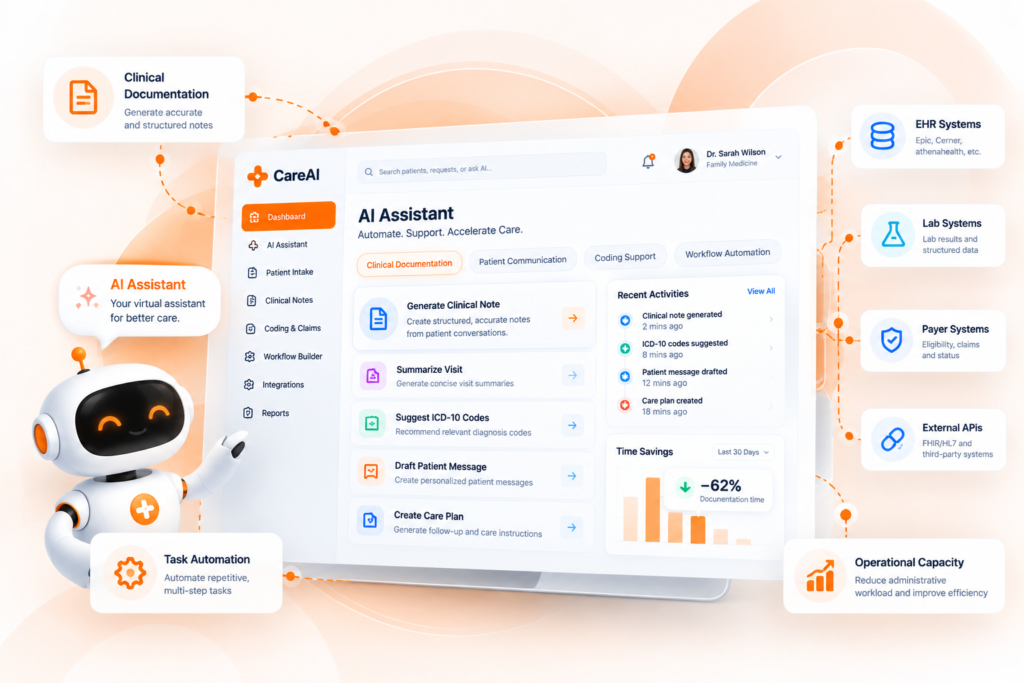
Move beyond isolated AI demos by connecting models to healthcare data, product workflows, and application logic while keeping security, accuracy, and control in the engineering design.
- LLM Integration
- Clinical Context
- Healthcare Knowledge Systems
- AI APIs
- FHIR-Connected AI
How We Build
Custom Healthcare Products
Define the Product & Market Need
Typical timeline: 1–3 weeksWe clarify the problem the product needs to solve, who will use it, and what the first release needs to prove.
We look at:
- Target users and use cases
- Healthcare workflows
- Product goals
- MVP priorities
- Existing solutions and systems
- Integration requirements
- Technical feasibility
A defined product scope, MVP direction, and practical development roadmap.
Shape the Product Experience
Typical timeline: 2–4 weeksWe turn requirements into product experiences that make sense for the people using them, whether they are patients, providers, administrators, or care teams.
This can include:
- User journeys
- Clinical workflow mapping
- Healthcare UX
- Web and mobile experiences
- Product prototypes
- Usability validation
A product experience that can be reviewed and validated before significant engineering begins.
Engineer the Product Foundation
Typical timeline: 2–4 weeksWe establish the technical foundation needed to support the first release without creating unnecessary constraints for future product development.
This may include:
- Product architecture
- Domain and data modeling
- API and integration strategy
- EHR connectivity approach
- FHIR and HL7 requirements
- Identity and access model
- Deployment architecture
A product architecture aligned with the roadmap, users, data, integrations, and technical requirements.
Develop the MVP
Typical timeline: 8–16+ weeksThe healthcare MVP development phase focuses engineering effort on the workflows and capabilities that deliver the product's core value.
Development can include:
- Web applications
- Mobile applications
- Backend services
- Healthcare APIs
- Clinical workflow engines
- Data processing
- AI-enabled capabilities
A working MVP ready for real-world testing and integration.
Integrate & Validate
Typical timeline: 3–8+ weeksThe product is tested within the healthcare environment it is intended to operate in, including its data flows and external dependencies.
Validation can cover:
- EHR/EMR integrations
- FHIR and HL7
- Healthcare APIs
- Clinical data exchange
- End-to-end workflows
- Integration failure scenarios
- Clinical usability
- User acceptance
A validated healthcare product ready for production release.
Control Product Costs Before Development Scales
Avoid spending heavily on features that haven’t been validated. Define the right MVP scope, prioritize core product capabilities, and invest in engineering where it matters most.
Why Choose HealthApp Systems
Faster Time-to-Market
Faster Product ReleasesMove from validated product requirements to a working release faster with focused product engineering and healthcare experience.
Flexible Engagement
3X More FlexibilityScale engineering support around your product stage, with 3X more flexibility to choose between an MVP team, specialized expertise, or full product development.
Cost Efficiency
Controlled MVP SpendControl product development costs by prioritizing MVP scope, reducing rework, and avoiding unnecessary engineering before validation.
Compliance by Design
Built In EarlyAddress healthcare security, privacy, access controls, auditability, and regulatory requirements early in the product architecture.
Integration Expertise
30% Faster Integration CyclesConnect products with EHRs, FHIR, HL7, APIs, devices, and third-party systems with 30% faster integration cycles, without treating interoperability as a final-stage task.
Product Quality
Validated Before ReleaseValidate healthcare workflows, data exchanges, integrations, and user experiences before release to reduce defects and costly changes later.
Let’s Talk About
Your Product Idea
Tell us what you’re considering, and get practical input on the product scope, technical approach, and next steps before you decide how to build it.
- Product discovery & MVP planning
- Healthcare UX & workflow design
- EHR, HL7 & FHIR interoperability
- Healthcare product engineering
Frequently Asked Questions
There is no useful flat price for custom healthcare software. In our experience, the biggest cost drivers are the number of workflows, EHR or third-party integrations, data migration, user roles, security requirements, and whether the application needs to support multiple organizations.
A provider portal and a multi-tenant healthcare platform can have very different engineering requirements. We typically scope the architecture, integrations, functionality, and delivery phases first, then estimate the project based on the actual requirements.
The timeline depends more on what the software needs to connect to and do than on the number of screens. A focused application can move to an initial release in a few months, while an enterprise healthcare platform may require a longer phased rollout.
EHR integrations, complex clinical workflows, data migration, security requirements, and testing can all add time. Defining the MVP and technical architecture early helps separate what needs to launch first from what can follow.
Yes. We work with both FHIR-based APIs and HL7 interfaces depending on the systems and data being exchanged. The important part is not simply connecting an endpoint; the integration needs to handle authentication, data mapping, message validation, error handling, and the specific workflow behind the exchange.
FHIR is commonly used for modern API-based connectivity, while HL7 remains important across many established healthcare environments.
Yes. Custom applications can integrate with existing EHRs through FHIR APIs, HL7 interfaces, SMART on FHIR, vendor APIs, or other supported connectivity options.
The approach depends on the EHR and what information needs to move between systems. For example, an application may need patient demographics, encounters, medications, clinical observations, or scheduling data. We first map those requirements to the available interfaces rather than assuming every EHR integration works the same way.
Yes. Replacing a legacy healthcare system does not always mean rebuilding everything at once. A phased modernization approach can preserve critical functionality while gradually introducing modern APIs, application architecture, cloud infrastructure, and new user experiences.
Where appropriate, existing databases and workflows can be assessed before deciding what to retain, refactor, migrate, or replace. This reduces unnecessary disruption while giving the organization a practical path away from aging technology.
HIPAA needs to influence the architecture from the beginning, not become a checklist before launch. Depending on the application, this can include role-based access, authentication, encryption, audit logging, secure data handling, controlled environments, and appropriate infrastructure safeguards.
We also consider where protected health information enters, moves through, and is stored in the application. The specific controls depend on the software, users, integrations, and deployment environment.
Yes. This is one of the main reasons organizations consider custom development. Specialty workflows can be built around the way a particular care team documents, schedules, communicates, bills, or manages patients.
The software can also use configurable forms, roles, rules, and workflows rather than hard-coding every variation. This is particularly useful when a standard platform forces clinicians or administrative teams to create workarounds around their actual processes.
Scalability has to be considered before the first release. We look at application architecture, database design, API patterns, infrastructure, workload characteristics, and expected growth rather than simply adding server capacity later.
For healthcare platforms, scalability may also mean supporting additional organizations, specialties, users, integrations, and growing clinical data volumes. A modular foundation makes it easier to expand functionality without turning every new requirement into an architectural rewrite.
Yes. But healthcare data migration is more than moving records from one database to another. Source data often has different structures, formats, identifiers, and levels of completeness.
The process typically involves source assessment, data mapping, transformation, validation, deduplication, testing, and controlled migration. Where multiple systems are involved, we also establish how the data should be represented in the new platform so future integrations do not recreate the same fragmentation.
Start with the requirements, not the technology preference. If an existing platform supports your workflows, integrations, scalability, and operational requirements with reasonable customization, buying may make sense.
Custom development becomes more relevant when those limitations start affecting the business or when you need control over workflows, data, integrations, and the technology roadmap. The comparison should include implementation cost, customization, integration effort, ongoing maintenance, scalability, and the long-term cost of working around the platform.