
Custom Healthcare SaaS Development Company
2X Faster SaaS Expansion With Scalable Healthcare Platforms
We design, develop, and modernize secure healthcare SaaS platforms around your business model, from multi-tenant applications and patient platforms to healthcare APIs, integrations, and automation, without compromising scalability, security, or user experience.
The Capabilities Behind Successful
Scalable Healthcare SaaS
Multi-Tenant Architecture
Design one product foundation that securely serves multiple healthcare organizations without creating separate applications.
SaaS Monetization
Build the product logic needed to turn platform usage into predictable recurring revenue.
Tenant Administration
Give each organization control over its users, roles, settings, and product access without affecting other tenants.
Healthcare Integration
Create a reusable integration layer that connects different customer environments without hard-wiring the product to one healthcare system.
Tenant-Aware Product Configuration
Support customer-specific workflows and settings while keeping one maintainable product codebase.
Product Intelligence
Turn SaaS usage data into visibility into adoption, feature utilization, and customer behavior.
Healthcare SaaS
Products We Build
Scalable Platforms for Multi-Location Care Delivery
Build connected SaaS products for multi-location operations, patient engagement, and revenue-cycle workflows.
Multi-Location Healthcare Platforms
Build SaaS platforms that support multiple practices, locations, providers, and administrative teams without managing separate software instances.
Patient Engagement Platforms
Create secure SaaS experiences that connect patients with providers across intake, communication, scheduling, and ongoing care.
Revenue Cycle Platforms
Build SaaS products that centralize billing and revenue-cycle operations across practices, providers, and locations.
Healthcare SaaS Products Built for Scale
Build multi-tenant healthcare products across SaaS, virtual care, and AI-enabled workflows.
Healthcare SaaS Platforms
Turn healthcare applications into scalable, multi-tenant products through healthcare SaaS product development designed to support multiple customers and evolving subscription models.
Telehealth & Virtual Care SaaS
Build virtual care products that support multiple healthcare organizations while keeping patient, provider, scheduling, and clinical data securely separated.
Healthcare AI SaaS
Productize practical AI capabilities into scalable healthcare platforms rather than deploying isolated AI features.
Reusable Healthcare Products for Your Customers
Build white-label platforms and reusable integration capabilities that can be delivered across multiple healthcare customers.
White-Label Healthcare SaaS
Launch healthcare software under your own brand while using a scalable platform foundation designed for multiple customers.
Healthcare API & Integration SaaS
Turn complex healthcare connectivity into reusable SaaS capabilities that can serve multiple applications and customers.
Healthcare Data Products Built for Multi-Tenant Delivery
Build analytics and data platforms that unify healthcare data, reporting, and exchange across multiple customers.
Healthcare Analytics SaaS
Build multi-tenant analytics products that bring clinical, operational, and financial data together without creating separate reporting environments for every customer.
Healthcare Data Platforms
Create SaaS products that collect, normalize, manage, and exchange healthcare data across fragmented systems.
Production AI for Multi-Tenant
Healthcare SaaS
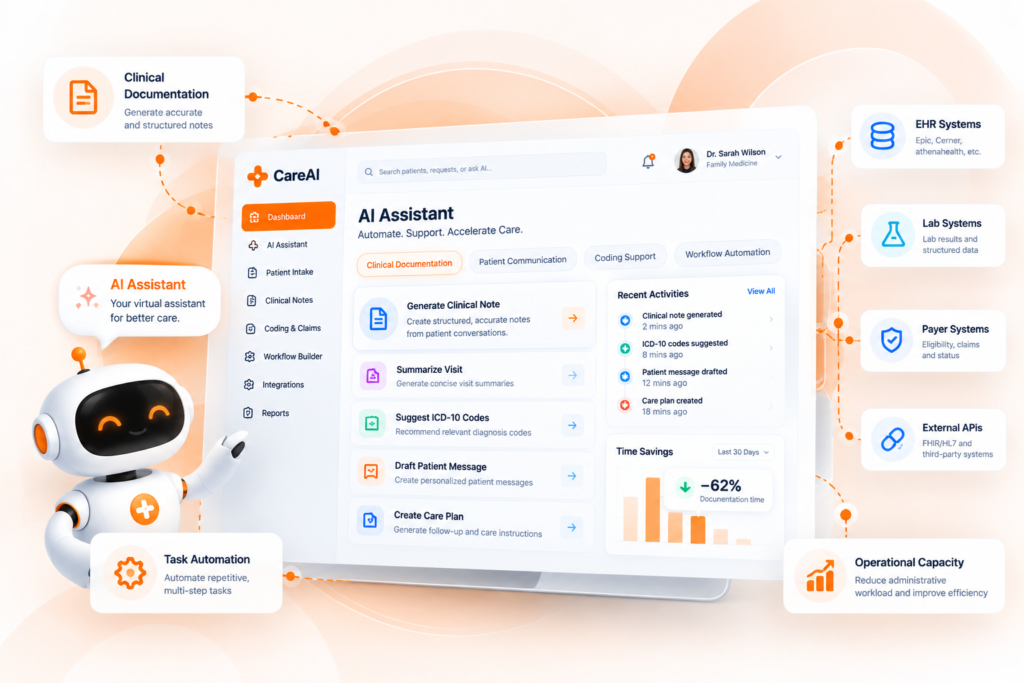
Build secure AI capabilities that scale across customers, data environments, and workloads without compromising tenant isolation, healthcare interoperability, or platform performance.
- LLM Integration
- Multi-Tenant AI
- PHI Isolation
- AI APIs
- FHIR-Based Intelligence
How We Build
Healthcare SaaS
Define the Product & SaaS Model
Typical timeline: 1–3 weeksWe start by understanding what you're building, who will use it, and how the product will serve multiple organizations.
We look at:
- Target customers and users
- Core healthcare workflows
- Product and business goals
- SaaS pricing or subscription model
- Tenant and organization model
- MVP priorities
- Customer-specific requirements
- Integration needs
A defined product scope, MVP priorities, and healthcare SaaS development roadmap.
Design the SaaS Architecture
Typical timeline: 2–4 weeksWe turn the product requirements into an architecture that separates customer data and access while keeping the platform scalable as tenants, users, and integrations grow.
This may include:
- Multi-tenant architecture
- Tenant and user management
- Data architecture
- API strategy
- Authentication and authorization
- Healthcare integration architecture
- Cloud infrastructure
- Security considerations
A healthcare SaaS architecture aligned with your product model, data, integrations, and growth plans.
Design the Product Experience
Typical timeline: 2–4 weeksA SaaS product has different experiences for patients, providers, customer administrators, and platform administrators. We design each around the tasks they need to complete.
This includes:
- User journeys
- Web and mobile interfaces
- Provider workflows
- Patient experiences
- Organization administration
- Platform administration
- Prototypes and design validation
A clear product experience ready for development.
Develop the SaaS Platform
Typical timeline: 8–16+ weeksOur healthcare SaaS developers build the core product around the approved roadmap and architecture.
Depending on the product, development can include:
- Web and mobile applications
- Multi-tenant capabilities
- Tenant isolation and data segregation
- User and organization management
- Subscription and billing workflows
- Backend services
- Healthcare APIs
- Databases
- AI-enabled capabilities
- Cloud infrastructure
A working healthcare SaaS platform ready for integration and validation.
Integrate & Validate
Typical timeline: 3–8+ weeksYour SaaS may need to work with different systems used by different customers. We integrate and validate the connections your product requires.
This can include:
- EHR/EMR systems
- FHIR APIs
- HL7 interfaces
- Laboratories
- Imaging systems
- Payers
- Medical devices
- Third-party healthcare applications
- Tenant-specific configurations
A tested SaaS product that works with the healthcare ecosystem it was designed for.
Launch, Monitor & Grow
Typical timeline: OngoingLaunching the first version is only the beginning. We support the platform as customers, usage, integrations, and product requirements evolve.
This can include:
- Cloud deployment
- Production monitoring
- Performance optimization
- Security updates
- Application maintenance
- New feature development
- Platform modernization
- Scalability improvements
A scalable SaaS platform ready to support more customers, users, integrations, and product capabilities without redesigning the foundation.
Scale Your SaaS, Not Your Costs
Build a healthcare SaaS foundation that supports more customers, users, and integrations without multiplying infrastructure, maintenance, and engineering costs.
Why Choose HealthApp Systems
SaaS Architecture
Multi-Tenant ReadyBuild scalable foundations designed for multiple customers, growing usage, integrations, and evolving product requirements.
Faster Market Entry
Up to 30% FasterAchieve up to 30% faster development cycles with focused healthcare engineering, reusable components, and phased delivery.
Scalable Delivery
Built for GrowthAdd customers, users, features, and integrations without rebuilding the platform as your SaaS business grows.
Lower Ownership Costs
Efficient TCOControl long-term engineering and infrastructure costs through reusable architecture, efficient cloud resources, and fewer customer-specific changes.
Product Flexibility
3X More ConfigurationsSupport 3X more product configurations across customer workflows, roles, permissions, and settings without creating separate products for every healthcare organization.
Healthcare Integration
EHR · FHIR · HL7 · APIsConnect your SaaS platform with EHRs, EMRs, FHIR APIs, HL7 systems, labs, payers, and other healthcare technologies.
Let’s Talk About Your
Healthcare Software
Share what you’re trying to build, improve, or integrate. We’ll help you understand the right technical approach, scope, and next steps.
- Workflow-driven software design
- EHR, HL7 & FHIR interoperability
- Cloud-ready scalable architecture
- Healthcare-grade security practices
Frequently Asked Questions
The cost depends on the SaaS model and the engineering required to support it. The biggest factors are multi-tenant architecture, customer and user management, subscription and billing logic, healthcare integrations, data requirements, security controls, and the scope of the first release. A single-workflow SaaS platform can be very different from an enterprise platform serving multiple organizations. We usually define the tenant model, core functionality, integrations, and MVP scope before estimating the investment.
A focused SaaS MVP can typically be delivered in a few months, while a production platform with multiple integrations and enterprise requirements takes longer. The timeline is influenced by tenant architecture, product complexity, healthcare integrations, security requirements, billing, data migration, and testing. We generally separate the initial release from later capabilities so the platform can reach customers without waiting for every planned feature.
The architecture needs to separate each customer's data, users, permissions, and configuration while allowing the underlying platform to be shared where appropriate. We define the tenant model early, including data isolation, organization hierarchy, authentication, authorization, configuration, and resource usage. The right approach depends on the product's security requirements, customer profile, expected scale, and how much tenant-specific customization the platform needs.
Yes. A healthcare SaaS platform can connect with EHRs through FHIR APIs, HL7 interfaces, SMART on FHIR, vendor APIs, and other supported methods. The challenge is usually not the connection itself but handling differences in data models, authentication, permissions, workflows, and available interfaces across EHRs. We design the integration layer so additional healthcare systems can be added without creating a separate architecture for every customer.
Yes. A well-designed SaaS platform can provide configurable workflows, forms, roles, permissions, and business rules without maintaining a separate codebase for every customer. The key is deciding what should be configurable and what should remain part of the core product. Too much customer-specific customization can create a maintenance problem, so we design configuration boundaries that preserve the underlying product architecture.
Tenant isolation is designed at the architecture and data layers rather than added after development. Depending on the product, isolation can involve separate databases, schemas, tenant-aware data models, access controls, encryption, and application-level authorization. The appropriate model depends on the sensitivity of the data, customer requirements, infrastructure, and expected scale. Access and isolation should also be validated through testing before production.
Yes. SaaS platforms can support multiple plans, recurring subscriptions, upgrades, downgrades, usage-based pricing, billing cycles, entitlements, and account-level limits. The important part is connecting billing logic to actual product access. For example, changing a customer's plan may need to automatically change users, features, storage, API usage, or other entitlements. Those rules should be defined early because they affect both the architecture and customer experience.
Yes, but the migration usually involves more than moving the existing application to the cloud. We first assess the legacy architecture, database, workflows, customer structure, integrations, and data dependencies. The system can then be refactored toward tenant-aware architecture, modern APIs, cloud infrastructure, and improved user experiences in phases. This approach allows critical functionality to remain available while the underlying platform evolves.
Scalability needs to account for more than server capacity. We design around growing tenants, concurrent users, transactions, integrations, data volumes, and background workloads. Application services, databases, APIs, caching, queues, cloud infrastructure, and monitoring all need to work together. We also consider noisy-neighbor risks, where one customer's usage can affect others. The goal is to increase platform capacity without repeatedly redesigning the core architecture.
The decision depends on how closely an existing product matches your business model, workflows, integrations, and customer requirements. Buying can make sense when standard functionality covers most needs. Building becomes more relevant when you need control over the product roadmap, multi-tenant model, integrations, customer experience, or monetization. The comparison should include development cost, licensing, customization, integration effort, scalability, maintenance, and the long-term economics of owning the platform.