
Healthcare Software Modernization
Modernize Healthcare Software 2X Faster Without a Full System Rebuild
We modernize aging healthcare applications without disrupting the systems your teams depend on, removing technical bottlenecks, improving integration flexibility, and making future releases easier to scale.
Core Capabilities For
Healthcare Software Modernization
Legacy Assessment
Identify technical debt, aging components, brittle dependencies, and performance constraints before deciding what should be retained, refactored, or replaced.
Architecture Reengineering
Restructure tightly coupled applications into cleaner, more maintainable architectures without forcing a full rebuild.
Cloud Readiness
Prepare healthcare applications for cloud environments with better resilience, scalability, and deployment flexibility.
Integration Upgrade
Replace fragile point-to-point connections with flexible APIs and interoperability layers that are easier to maintain and extend.
Data Transformation
Improve how clinical, operational, and financial data is structured, migrated, and accessed across legacy and modern systems.
Release Acceleration
Improve deployment and delivery practices so teams can ship healthcare software upgrades faster with less risk to critical healthcare operations.
Healthcare Software Modernization Solutions We Offer
We modernize aging healthcare software across architecture, cloud, integrations, and data without forcing a full-platform rebuild.
-
For Legacy Applications
-
For Cloud & Infrastructure
-
For Integrations &
Interoperability -
For Data & Analytics
-
For Product & User
Experience -
For Engineering & Delivery
Legacy Application Modernization
Upgrade aging healthcare applications that are difficult to maintain, slow to change, or dependent on outdated technology. Our healthcare legacy software modernization approach focuses on improving what creates the most technical and operational friction.
Monolith-to-Modular Transformation
Break tightly coupled applications into cleaner modules and services that are easier to maintain, deploy, and scale.
Cloud Migration & Replatforming
Move healthcare applications to modern cloud environments without carrying unnecessary legacy constraints into the new infrastructure.
Infrastructure Optimization
Improve performance, resilience, and infrastructure efficiency across modernized healthcare applications.
API & Integration Transformation
Replace brittle interfaces and point-to-point connections with cleaner API and interoperability patterns.
Legacy EHR Integration Upgrade
Modernize the way older applications connect with EHRs and other clinical systems without disrupting existing workflows.
Healthcare Data Modernization
Restructure legacy data environments so clinical, operational, and financial information is easier to access, govern, and use.
Analytics-Ready Transformation
Prepare modernized applications for better reporting, analytics, and downstream data use.
Healthcare Platform Modernization & Product Reengineering
Modernize the underlying product without losing the workflows, integrations, or business logic users already depend on. Our healthcare platform modernization services can improve the product foundation while preserving what already works.
Legacy UI/UX Upgrade
Refresh outdated interfaces while preserving core workflows and reducing disruption for clinical and operational users.
DevOps & Release Transformation
Improve how healthcare applications are tested, deployed, monitored, and released across environments.
Application Performance Engineering
Identify and remove performance bottlenecks that slow users, integrations, and critical healthcare workflows.
Build AI-Ready Healthcare Software Without Rebuilding from Scratch
Modernize legacy applications to support AI use cases through cleaner data access, flexible APIs, scalable infrastructure, and safer model integration.
- AI Readiness Assessment
- Legacy Data Access
- Model Integration
- RAG Architecture
- Workflow Automation
- AI Governance
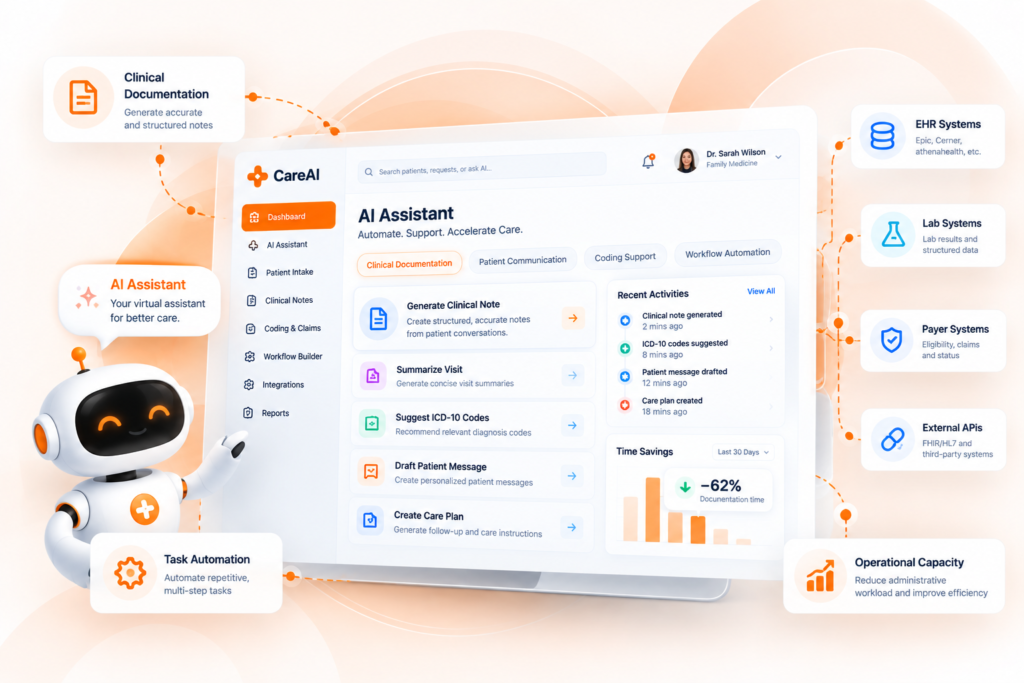
Population Health Integrations by Business Workflow
Patient & Clinical Data Intake
Oracle Health
athenahealth
eClinicalWorks
MEDITECH
NextGen Healthcare
Greenway Health
HL7 v2
FHIR
SMART on FHIR
Claims, Eligibility & Utilization Data
Change Healthcare
Availity
TriZetto
Experian Health
X12 837
X12 835
X12 270/271
Utilization Data
Risk Stratification & Population Segmentation
CMS Data
Clinical Risk Feeds
Claims Data
SDOH Data
Patient Demographics
Care Gap & Quality Management
Care Gap Feeds
Preventive Care Data
Screening Data
Follow-Up Status
Program Performance Metrics
Care Management & Intervention Workflows
Arcadia
Lightbeam Health Solutions
HealthEC
ZeOmega
Persivia
Care Management APIs
Medication & Pharmacy Insights
RxNorm
NCPDP
Pharmacy Claims Data
Medication History APIs
Formulary Data
Lab & Diagnostic Data Exchange
Labcorp
LIS/LIMS Interfaces
HL7 ORU
Diagnostic APIs
DICOM
Patient Outreach & Engagement
SendGrid
Firebase Cloud Messaging
Apple Push Notification Service
Secure Messaging APIs
Outreach APIs
HIE & Cross-System Data Exchange
Redox
InterSystems HealthShare
Mirth Connect
Rhapsody
HIE APIs
CDA/C-CDA
Identity, Access & Security
Auth0
Microsoft Entra ID
AWS Cognito
OAuth 2.0
OpenID Connect
Analytics & Population Reporting
Databricks
Microsoft Fabric
Google BigQuery
Amazon Redshift
Power BI
Tableau
Looker
Cloud & Platform Operations
Microsoft Azure
Google Cloud
Docker
Kubernetes
Datadog
Grafana
Prometheus
OpenTelemetry
How We Deliver Healthcare Software Modernization
Legacy Architecture Assessment
We review the current application to identify technical debt, performance issues, brittle integrations, and components that no longer support product goals.
We assess:
- Legacy Architecture
- Technical Debt
- Dependencies
- Performance Constraints
- Integration Risks
- Upgrade Priorities
A clear view of what should be retained, refactored, replatformed, or replaced.
Target Architecture Planning
We define the modernization path based on business priorities, system constraints, migration risk, and delivery timelines.
We define:
- Target Architecture
- Modernization Scope
- Migration Phases
- Technology Choices
- Dependency Sequencing
- Rollback Strategy
A practical roadmap that avoids unnecessary full-system replacement.
Application Refactoring & Modularization
We refactor tightly coupled code, simplify service boundaries, and upgrade outdated frameworks without breaking critical workflows.
We build:
- Modular Components
- Cleaner Service Boundaries
- Updated Frameworks
- Refactored Code
- API Layers
- Reusable Services
A more maintainable application that is easier to change and extend.
Data & Integration Transformation
We modernize how healthcare data moves across EHRs, APIs, legacy systems, and downstream applications.
We improve:
- HL7/FHIR Connectivity
- API Architecture
- Data Models
- Integration Layers
- Data Migration
- Interface Reliability
Outcome: Cleaner data exchange with fewer integration bottlenecks.
Migration & Performance Validation
We test modernized components against real workloads, workflows, integrations, and failure scenarios before production rollout.
We validate:
- Functional Workflows
- Data Integrity
- Integration Behavior
- Load & Performance
- Security Controls
- Migration Readiness
Lower rollout risk and fewer production surprises.
Phased Deployment & Stabilization
We release modernized components in controlled phases with monitoring, rollback controls, and post-launch tuning.
We optimize:
- Phased Releases
- CI/CD Pipelines
- Monitoring
- Rollback Controls
- Performance Tuning
- Post-Launch Stability
Continuous healthcare system modernization with less disruption and a safer path to long-term scale.
What Makes Us a Trusted Healthcare Software Modernization Company
We modernize healthcare software with zero-trust access controls and API security while preserving critical workflows and integrations. This reduces migration risk and keeps sensitive data protected during modernization.





Know What Your Healthcare Software Modernization Will Cost Before You Rebuild
Get a clear estimate based on legacy complexity, architecture changes, cloud scope, integrations, data migration, and release requirements, so you can modernize with the right budget and priorities.
Why Choose HealthApp Systems
01
Modernization Experience
With 18+ years of healthcare technology experience, we understand medical software modernization and how to update aging systems without losing critical workflows, integrations, or operational continuity.
02
Architecture Depth
We assess monoliths, legacy frameworks, service dependencies, APIs, and infrastructure before defining the right refactoring, replatforming, or reengineering path.
03
Migration Control
We use phased modernization, dependency sequencing, rollback planning, and validation to reduce the risk of disrupting production healthcare systems.
04
Integration Continuity
We preserve and improve EHR, HL7/FHIR, API, and downstream system connectivity while replacing brittle legacy interfaces and dependencies.
05
Cost Efficiency
We focus investment on the components creating the most technical debt, performance issues, or delivery friction instead of pushing unnecessary full-system rebuilds.
06
Future Readiness
We modernize applications for easier releases, cloud adoption, stronger interoperability, and future AI or analytics use without locking teams into another rigid architecture.
Have Legacy Systems Slowing You Down?
We’ll help you modernize the right parts of your application, reduce technical debt, improve performance, and create a safer path to cloud, integration, and product growth.
- Lower Technical Debt
- Faster Release Cycles
- Safer Modernization
- Better System Performance
Frequently Asked Questions
Healthcare software modernization upgrades aging applications, architecture, infrastructure, integrations, and data without necessarily replacing the entire system.
It can include refactoring, replatforming, cloud migration, API upgrades, framework updates, data transformation, and deployment improvements.
Common signs include slow releases, recurring performance issues, fragile integrations, outdated frameworks, rising maintenance costs, and difficulty adding new capabilities.
If every product change requires major rework or creates operational risk, healthcare software modernization services are usually worth evaluating.
A full rebuild is not always necessary.
Healthcare application modernization can retain stable business logic and workflows while replacing the parts creating the most technical debt. A rebuild makes more sense when the existing architecture fundamentally limits security, scalability, maintainability, or future product direction.
Yes. Legacy healthcare system modernization can reduce disruption by upgrading components incrementally instead of replacing the entire application at once.
Parallel environments, migration validation, rollback planning, and controlled releases help protect critical clinical and operational workflows during the transition.
We first assess architecture, dependencies, technical debt, integrations, performance constraints, and business priorities.
Components are then classified based on risk, value, maintainability, and migration effort so modernization investment is focused where it creates the most impact.
HealthApp Systems identifies tightly coupled components, service boundaries, dependencies, and high-change areas before defining a modularization strategy.
The application can then be decomposed gradually into cleaner modules or services without forcing an immediate microservices rewrite.
Yes. Legacy point-to-point interfaces can be replaced or simplified using modern APIs, FHIR, integration layers, and cleaner interface patterns.
This can reduce integration maintenance and make it easier to connect additional EHRs, payer systems, labs, devices, or third-party platforms.
Not always.
Cloud migration should be based on actual infrastructure, scalability, resilience, and operational requirements. Some applications benefit from rehosting or replatforming, while others may need architecture changes before moving to the cloud.
HealthApp Systems uses phased migration, dependency mapping, architecture validation, data verification, performance testing, and rollback planning before production cutover.
This helps reduce unexpected failures and keeps critical healthcare workflows operational while modernized components are introduced.
Yes. Custom healthcare software modernization can preserve existing workflows and business rules while the underlying architecture, frameworks, integrations, or infrastructure are upgraded.
This is especially useful when the application still supports valuable operational processes but the technology underneath has become difficult to maintain.
The timeline depends on application size, technical debt, integration complexity, migration scope, and whether modernization is phased or performed as a broader transformation.
A focused component upgrade may take a few months, while enterprise-scale modernization can require multiple phased releases.
A focused modernization initiative may start around $ 50,000 – $ 100,000, while larger programs involving cloud migration, architecture reengineering, integration upgrades, data transformation, and enterprise-scale rollout can range from $ 150,000 – $500,000+.
The final cost depends mainly on legacy complexity, migration risk, integration depth, and the percentage of the system being modernized.